Diana

Easy Paper Marbling

May 20th, 2013
by Diana

Marbling Paper with Children/ The Eric Carle Museum Studio Blog

This month I’ve been saying a lot of ‘goodbyes’ to student staff members as they leave for summer break. It makes me realize how fortunate we’ve been to work with such a stellar group of student employees over the years and see them move on to careers in art, museums and education.  We invited our very talented former Studio intern, Anna McNeary, to share this marbling paper activity she taught recently to children at ArtSpace Charter School in Swannanoa, NC.

Anna McNeary

Anna McNeary working on her final Studio project, fall 2010

I spent a very fruitful semester interning in the Art Studio during autumn of 2010, while I was attending Smith College. Since moving on from both the Carle and Smith, I’ve continued to pursue opportunities in art education. After I graduated last May, I moved to Asheville, NC and began working in the after-school program at ArtSpace Charter School. ArtSpace is an arts-integrated K-8 public charter school in Swannanoa, NC.

ArtSpace is a great learning and teaching environment for any person who accepts art as a universal teaching tool, since the philosophy of the school is based on a belief in creative learning across academic disciplines. The projects that I tried with ArtSpace students were directly informed by my experiences at the Carle. Visual Thinking Strategies and the Reggio Emilia approach to teaching were often on my mind, and I gravitated toward open-ended, process-oriented projects intended to let the kids explore materials and experiment with technique. This approach to making art with children is, not surprisingly, very compatible with ArtSpace’s culture of learning.

Marbling Paper with Children/ The Eric Carle Museum Studio Blog

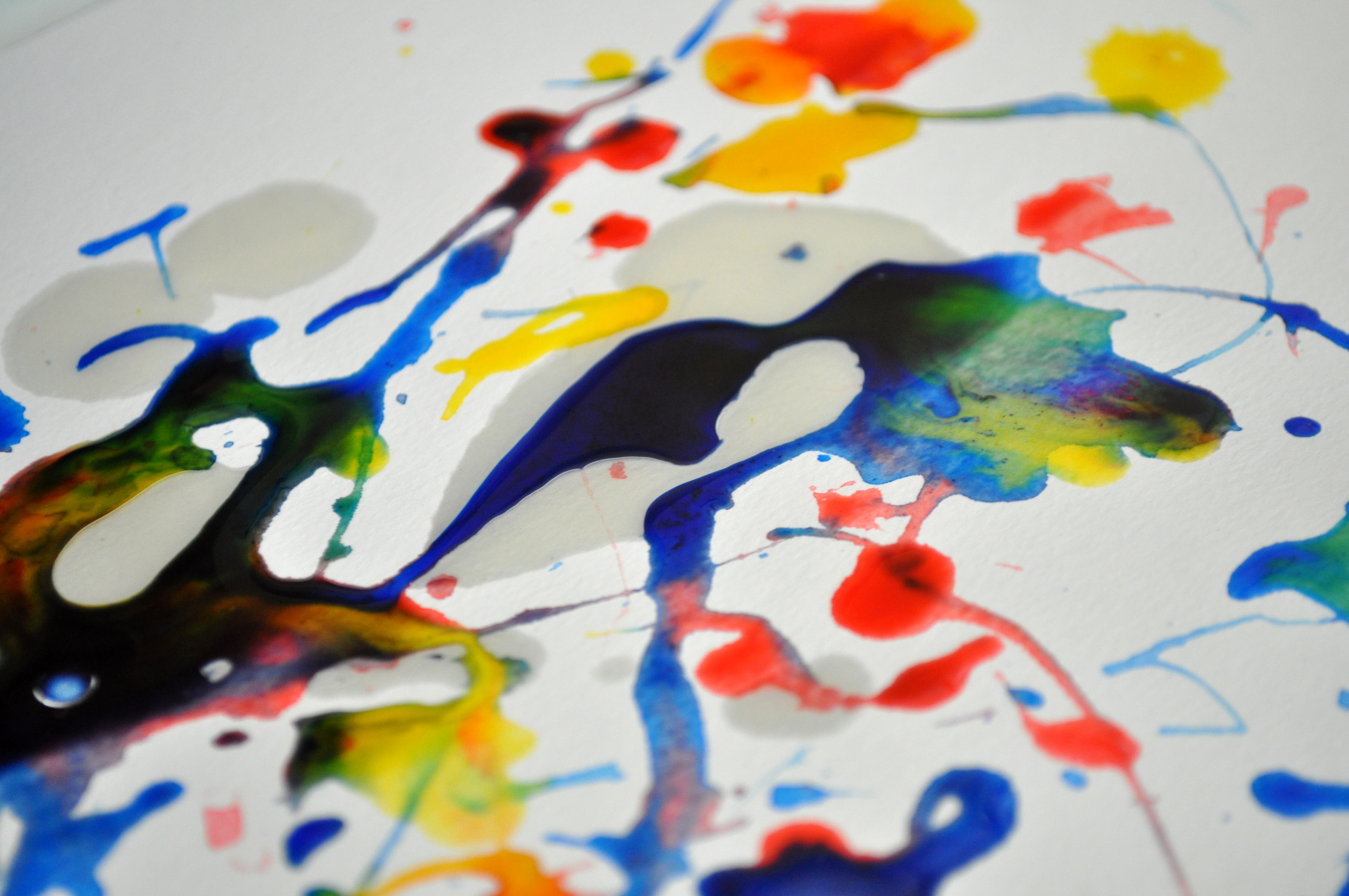
I’m a printmaker, so some of my favorite projects drew on printmaking concepts. The transfer of images is perhaps the most central concept in printmaking, and it’s really what made our paper marbling activity so surprising and exciting. For those unfamiliar with the medium, marbling is the process of creating designs by floating pigment on the surface of a liquid substance, like water or oil. When you gently press a substrate like paper or cloth to your colored surface, you’ll get a swirly, psychedelic transferred design. Here’s an accessible and kid-friendly interpretation of marbling that I found and adapted for AfterCare.

Materials:

containers with seal-able lids

shallow pans

vegetable oil

food coloring

forks, spoons, skewers

sturdy paper, such as card stock

Marbling Paper with Children/ The Eric Carle Museum Studio Blog

In a few containers with tightly seal-able lids (mason jars work well), I combined about 1/4 cup vegetable oil with a generous amount of food coloring. I shook up my “dye” vigorously enough to get it looking pretty homogenous. When I arranged our workspace, I put down plenty of newspaper over two long tables, and then put our supplies in the center. I set out two rectangular cake pans filled about halfway with water, our jars of colored oil, spoons, forks, wooden skewers, and a stack of light-colored card stock. I knew this activity had the potential to be messy, so I put the marbling station in the center of the workspace so that kids could surround the materials from all sides, and then quickly transfer drippy paper to the newspaper at either side.

Marbling Paper with Children/ The Eric Carle Museum Studio Blog

I had a few eager marblers right off the bat, and once we got going, more inquisitive kids joined us. I had them start by spooning drops of oil onto the water. For the sake of keeping our designs from getting too muddy, we had a pan for warm colors (orange and red) and cool colors (blue and green). After they had added enough for the surface to be fairly crowded with colorful blobs, we used the forks and skewers to stir the oil into swirly patterns. Then, one by one we each touched the card stock to the liquid for about three seconds. It was such fun to see the kids’ thrilled reactions to their beautiful marbled prints–their enthusiasm was palpable, and soon we had a quick-paced marbling factory running at the back of the classroom!

The kids were responding to one of the most captivating things about printmaking, which may be my favorite part of the process: the small moment of suspense before you see the print you just pulled. Will it be beautiful, weird, unexpected, perfect, or all of those things? It’s a joy to watch kids have that experience, and it’s a great reminder of why art education is so important.

Marbling Paper with Children/ The Eric Carle Museum Studio Blog

For more information about The Art Studio Internship Program, CLICK HERE.

There’s still time to submit your caterpillars to our CALL FOR CATERPILLARS contest! CLICK HERE for more information and how you and your child can enter.


Meghan

May Flowers and A Garden of Ordinary Miracles

May 17th, 2013
by Meghan

GardenofOrdinaryMiracles

Two weekends ago, an exhibition of original art by Robert Zakanitch for his book A Garden of Ordinary Miracles: An Alphabet Book opened in the Museum’s Central Gallery. To celebrate the exhibition and the fact that it was finally spring here in Amherst, MA I made a flower-drawing station in the Studio.

flower drawing in the Studio - The Eric Carle Museum

We need a new display in the Studio’s entry window, one that doesn’t block the view into the studio, so I chose permanent markers and clear acetate squares as the drawing tool and drawing surface for this activity. When we have about 50 drawings, I plan to start stringing them into garlands with with fishing line to create a friendly welcome into our space.

drawingflowers

Some guests have drawn the flowers we have in the vases realistically, others are drawing flowers from their imagination.

MayFlowersInvestigation

Some guests are more interested in studying (very closely!) the flowers’ textures.

MayFlowersSetup

Spring is a great time to draw from nature. Head outside with your kids and look closely at the new leaves and budding flowers. Study them again in a few weeks when they bloom! Read a flower related picture book, such as Miss Rumphius by Barbara Cooney, and if you’re in our area, come and see this amazing exhibition.

Sign

In fact, if you’re in our area why not come tomorrow, May 18th? It happens to be a very special day with Robert Zakanitch.
He’ll be giving a gallery (or should I say garden?) tour at 11 am. At 1 pm he will be here in the studio to inspire guests to create big designs, visual surprises, and pleasing patterns using the shapes of one or more letters in their name. Learn more about these events here.

And then… visit the Studio sometime between May 22 and June 18th for our next public art project: From Found Materials to Flowers!

Diana

Printmaking with 4th and 5th Graders

May 15th, 2013
by Diana

Printmaking with 4th and 5th Graders/ Eric Carle Museum Studio Blog

I’m just back from a trip to Syracuse, New York area, where I worked with the students at Manlius Pebble Hill School. I taught 2 bookmaking sessions with 3rd graders in the morning and 2 printmaking sessions with 4th and 5th graders in the afternoon.  Fortunately, I remembered to pull out my phone and snag a few shots at the end of the last session of the day! Here are some of the beautiful and diverse monotype prints by the 4th and 5th graders.

Printmaking with 4th and 5th Graders/ Eric Carle Museum Studio Blog

We used Crayola brand Artista II washable tempera in magenta, turquoise and yellow. Any additional colors on the paper students created by overlapping different colored plates. The students worked in reductive monotype, inking the whole plate and using tools to remove select areas of the paint.

Printmaking with 4th and 5th Graders/ Eric Carle Museum Studio Blog

To make the colors more transparent I mixed the paints with a good amount of Speedball brand Screen Printing Transparent Base. This is the best brand I’ve found to make tempera paints more transparent for printing or painting.

Printmaking with 4th and 5th Graders/ Eric Carle Museum Studio Blog

Printmaking with 4th and 5th Graders/ Eric Carle Museum Studio Blog

Thank you to the art teacher, Linda McGinley for all her help, and to the students at Manlius Pebble Hill School!

Diana

Latin Landscapes

April 30th, 2013
by Diana

Latin Landscapes/ The Eric Carle Museum Studio Blog

I thought you might be interested in seeing what Museum guests are up to in The Studio lately.

Latin Landscapes/ The Eric Carle Museum Studio Blog

The current Public Art Project is Latin Landscapes and guests are invited to capture the beauty of any outdoor space and create a picturesque panorama adapting the textured drawing style of illustrator Raul Colón.  The project is inspired by one of our current exhibitions, Latino Folk Tales: Cuentos Populares–Art by Latino Artists, on display now through June 9th. On the tables are oil pastels, colored pencils and watercolor paints, as well as plastic combs and forks for scoring the paper and making textured marks in the creamy oil pastels. Below are a few different interpretations of landscapes by some of our talented guests!

Latin Landscapes/ The Eric Carle Museum Studio Blog

It’s hard to see the scratched texture details in these photos, but close up the overlap of the paints and pastels makes a really beautiful effect.

Latin Landscapes/ The Eric Carle Museum Studio Blog

Latin Landscapes/ The Eric Carle Museum Studio Blog

Latin Landscapes/ The Eric Carle Museum Studio Blog

Latin Landscapes/ The Eric Carle Museum Studio Blog

Latin Landscapes/ The Eric Carle Museum Studio Blog

Latin Landscapes/ The Eric Carle Museum Studio Blog

Illustrator Raul Colón will visit The Carle on May 19th for his presentation, Art is a Mind Game.  Doors open at 11:45 and the presentation starts at 12:00 pm with a book signing to follow. It’s free with Museum Admission.

For more information about upcoming events at The Carle, click here.

Latin Landscapes/ The Eric Carle Museum Studio Blog

Sarah Johnston

Ribbon Window Shade

April 25th, 2013
by Sarah Johnston

Ribbon Window Shade/ THe Eric Carle Museum Studio Blog

My last post was about how we made a window hanging out of old marker caps and other plastic tops by stringing them onto wire.  I thought it would be fun to share one more of our window hanging ideas because I often get questions and interest from our visitors about the window screens we have created in The Studio.  The Ribbon Window Shade uses some of the same materials as our Plastic Cap Window Screen and is a good way to explore the art of weaving.  It also provides some shade during the sunny weather that should be on its way soon!  Here is a list of supplies you will need to make a window weaving for yourself.

DSC_0296

Materials:

Two tension rods that fit your window (We purchased ours at Target)

Duct tape to secure the rods

Colorful wire (We purchased ours at Home Depot)

Ribbons, strings, fabric strips, yarn or any other weaving material

DSC_0293

First, you will want to put both tension rods in your window and secure them well so that they don’t move or shift when you start weaving.  Our window is 58 inches wide and we hung the two rods 36 inches apart.  I found that if you put some duct tape around the ends of the rods to attach them to the window they were much more stable and less likely to move once you begin wrapping the wire and weaving the ribbons.

 DSC_0300

The wire that we used is the same cable wire that was used for the Plastic Cap Window Screen.  It is colorful cable wire that comes in a gray or black encasing which can be easily removed by peeling off the casing to reveal all the colorful wires.  I suggest cutting the wire while still in the casing into lengths that are double your window length, at most.  Otherwise the wire can get too long and tangles easily as you remove it from the casing.  I began adding the warp (the vertical strands in a weaving) by looping the wire around the top and bottom rods.  Secure the wire into place by wrapping the wire back onto itself.   After you have added many lengths of wire this way then you are ready for the weaving part.  I ended up doing 60 strands of wire to fill our window, but you may need to do more or less depending on the size of your window.

DSC_0291

We have quite a collection of ribbons, strings, fabric strips, and yarn and I found that starting at the top with some of the wider ribbon works well to get the pattern started.  To weave you should begin by pulling the ribbon OVER the first wire and UNDER the next and continue this pattern until you reach the other side (this back and forth pattern is done with the weft in a weaving).   The alternating pattern will create a fabric-like weaving.  And don’t be afraid to mix up your weaving a bit by going OVER two wires and UNDER the next one or making up any other weaving patterns you would like.  Whenever you run out of one ribbon or string pick up a new one and keep going.  I found that I could tuck some of the ribbon ends into place behind a wire but I also stapled a few together so they would be more secure.  I liked adding some of the thinner string in front of the thicker ribbons so that there were a few layers on top of each other in the weaving.  It is fun to experiment with whatever materials you are using to see how the textures and colors look with each other.

DSC_0299

I hope you get to try out making your own window weaving and please take a look at our other window display tutorials like the ones below.

Window Color Wheel

Rainbow Window Shades

Plastic Cap Window Screen


I would also love to hear about any other method you used to make a window weaving so please leave a comment  to let us know what you did!


Diana

Tom Peyton Memorial Arts Festival

April 22nd, 2013
by Diana

First United Methodist Church, host of the Tom Peyton Memorial Arts Festival

Last weekend, I ventured with fellow art educator, Sarah to sunny Louisiana, where spring is in full bloom!  The 47th Annual Tom Peyton Memorial Arts Festival at The First United Methodist Church in Alexandria, invited The Carle to lead a series of art workshops as part of their Children’s Day celebration.  It was our first trip to the central part of the state, and our hosts showed us what true southern hospitality is all about!

Tom Peyton Memorial Arts Festival

The weekend of art events kicked off on Friday night with the opening receptions for the adult and student juried art exhibitions at the church.  The event was very well attended and the show exhibited an array of 2D and 3D art pieces, all created by local artists and students.  Each year, with money from the Tom Peyton Memorial Fund, the church purchases one piece from the adult juried exhibition to display as part of the church’s permanent collection, and they’ve collected quite a beautiful gallery of work over the years.

Tom Peyton Memorial Arts Festival

The following day, Saturday, was Children’s Day and Sarah and I taught 6 workshops for children ages 4-13  in side-by-side rooms at the church’s school.  Thanks to the Tom Peyton Memorial Arts Fund, the art programs were free to the public and open to any children in the Alexandria community.

Throughout the day, Eric Carle’s newest DVD, Eric Carle, Picture Writer: The Art of the Picture Book played in the church’s auditorium, a great resource about Eric’s artistic process and his deep connection to art making throughout his life.  You can purchase the DVD from The Carle’s Bookshop.

Tom Peyton Memorial Arts FestivalTom Peyton Memorial Arts Festival


Here are some fun shots from Sarah’s busy morning “I Am an Artist” sessions, for ages 4-7.

at The Tom Peyton Memorial Arts Festival/ The Eric Carle Museum of Picture Book Art/ Studio Blog

Talking about Eric Carle’s artistic process of painting tissue papers and cutting them into collages.

at The Tom Peyton Memorial Arts Festival/ The Eric Carle Museum of Picture Book Art/ Studio Blog

Stamping some colorful art papers of their own.

Making Collages at The Tom Peyton Memorial Arts Festival/ The Eric Carle Museum of Picture Book Art/ Studio Blog

at The Tom Peyton Memorial Arts Festival/ The Eric Carle Museum of Picture Book Art/ Studio Blog

Cutting the papers into beautiful collages.

Below are some photos from the “Bookmaking Basics” workshops for children ages 6-8 later in the day.

at The Tom Peyton Memorial Arts Festival/ The Eric Carle Museum of Picture Book Art/ Studio Blog

Cutting unique shapes for their rainbow books.

at The Tom Peyton Memorial Arts Festival/ The Eric Carle Museum of Picture Book Art/ Studio Blog

at The Tom Peyton Memorial Arts Festival/ The Eric Carle Museum of Picture Book Art/ Studio Blog

Adding details to the popup accordion books.

Sarah and I ate lunch with our new friends by the church’s beautiful courtyard and fountain.  I could not stop gushing over the perfect weather we had during our quick weekend trip south.  It’s hard to believe, but it snowed in Amherst on the same day we were basking in the Louisiana sunshine!

at The Tom Peyton Memorial Arts Festival/ The Eric Carle Museum of Picture Book Art/ Studio Blog

After lunch, I taught two “Possibilities in Print” workshops for children ages 9-13.  There were a couple extra spots in the last workshop of the day so some of the festival organizers joined in on the fun too.

at The Tom Peyton Memorial Arts Festival/ The Eric Carle Museum of Picture Book Art/ Studio Blog

Two participants showing off their finished monotype prints.

at The Tom Peyton Memorial Arts Festival/ The Eric Carle Museum of Picture Book Art/ Studio Blog

Making marks in the paint creates interesting details.

at The Tom Peyton Memorial Arts Festival/ The Eric Carle Museum of Picture Book Art/ Studio Blog

The table of beautiful finished prints.

at The Tom Peyton Memorial Arts Festival/ The Eric Carle Museum of Picture Book Art/ Studio Blog

This creative mom’s message “Laugh, Live, Love” is apropos for this fabulous day of art making with the community.

Thank you especially to Aubrey Flynn who took such good care of us! Here I am with Aubrey and Sarah, celebrating the success of Children’s Day.

at The Tom Peyton Memorial Arts Festival/ The Eric Carle Museum of Picture Book Art/ Studio Blog

Also, a big thank you to everyone involved in organizing the Tom Peyton Memorial Arts Festival at The First United Methodist Church in Alexandria, and all of the children, parents and grandparents who participated in Children’s Day.  Sarah and I feel so fortunate to be a part of your celebration this year!

To find out more about the annual Tom Peyton Memorial Arts Festival click here.

For more information about bringing The Carle to your next event email us at artstudio@carlemuseum.org

Meghan

Week of the Young Child – Part 3

April 20th, 2013
by Meghan

Rounding out my series of posts celebrating The Week of the Young Child™ and Brain Building in Progress Week…

The BBIP campaign wants everyone to know that “A knowledgeable community and well-qualified education workforce give children the support they need to succeed in school and life.”

Though nothing can replace the knowledge I’ve gained through hands-on experiences with amazing students, mentors, and colleagues, there are a few resources connected with the approaches and philosophies that shape my approach to teaching and parenting. Here are a few of my favorites that hope might inspire you too:

First, a few books I reference multiple times a year:

The Eric Carle Museum

The Hundred Languages of Children Edited by Carolyn Edwards, Lella Gandini, and George Forman.

Childern, Art, Artists

Children, Art, Artists: The Expressive Languages of Children, the Artistic Language of Alberto Burri,  Edited by By Vea Vecchi and Claudia Giudici.

 Yet: The Drama of Drawing

It’s Not a Bird Yet by Ursula Kolbe

A Whole New Mind

A Whole New Mind by Daniel H. Pink

These are the books I’ll be looking at next. Have you read any of them?

Books in the Art Studio

Being a visual learning in the digital age means I’m quick to turn to the internet for inspiration. There are so many great sites and blogs I could make a long list, but I’ll just share 3 for now:

Visual Thinking Strategies

Tinkerlab

Not Just Cute


The Eric Carle Museum

We do alot of work at The Carle is in support of teachers, parents and caretakers to foster a love of learning that flows between home, school and community.  I hope you’ll continue to see us as a resource for informing and inspiring the ways you live with or teach young children!

What are the resources that inspire and inform you?

Meghan

Week of The Young Child part 2

April 8th, 2013
by Meghan

The Eric Carle Museum

In my last post, I shared that The Carle is celebrating The Week of the Young Child™ and Brain Building in Progress Week with a series of posts on this blog and hosting a special Brain Building in Progress Storytime in our Reading Library on Friday, April 19, at 10:30 am.

The Brain Building in Progress (BBIP) website clearly spells out how everyone has a stake and plays a role in building a “foundation for a lifetime of learning” in our young citizens. Its list of the Five Ways You Can Be a Brain Builder has inspired me to share few ways you might nurture brain building in the children in your life:

The Eric Carle Museum

BBIP suggests: “Make Any Moment a Brain Building Moment… through back-and-forth interactions and meaningful conversations with caring adults.” So what could those interactions and conversations look like?

  • Share a book with your young child. Picture books open up a space in which you can explore emotions, ideas and theories. Don’t be afraid linger on particular pages and talk about the pictures. Let the questions flow!  Need some book suggestions? Our shop has talked about some great selections for 0-3 years and 3-6 years.

The Eric Carle Museum

  • Explore the textures, shapes and colors of materials and objects you encounter together. To open a conversation, you might ask your child: “What do you notice about this paper/rock/flower/fabric/marker?” Even if they don’t yet speak back to you, they are wondering and thinking with their senses.

The Eric Carle Museum

The Eric Carle Museum

  • While young children are working with materials, you can invite conversation by saying: “Tell me about your idea.” Need some suggestions for materials or activities to try with your child? Check out our Infants & Toddlers, Nurturing Creativity at Home and Preschool posts, to start.

The Eric Carle Museum

Talk about the art you encounter together, whether in a museum or on the street. Art is everywhere and offers great opportunity for meaning-making. When you see a painting, collage, mural or sculpture in your community, you might ask: “What’s happening in this picture?” Learn more about open-ended conversations about art at vtshome.org

The Eric Carle Museum

*The Week of the Young Child™ is an annual celebration sponsored by the National Association for the Education of Young Children (NAEYC). The purpose of the Week of the Young Child™ is to focus public attention on the needs of young children and their families and to recognize the early childhood programs and services that meet those needs.

The 2013 Week of the Young Child™ is April 14–20, and the theme across the Commonwealth of Massachusetts is “Brain Building in Progress.”

Meghan

Week of the Young Child – Part 1

April 5th, 2013
by Meghan

  The Eric Carle Museum of Picture Book Art

The Carle, committed to inspiring a love of art and reading through picture books, hopes you will celebrate  The Week of the Young Child™ and Brain Building in Progress Week with us!

The Week of the Young Child™ is an annual celebration sponsored by the National Association for the Education of Young Children (NAEYC). The purpose of the Week of the Young Child™ is to focus public attention on the needs of young children and their families and to recognize the early childhood programs and services that meet those needs.

The 2013 Week of the Young Child™ is April 14–20, and the theme across the Commonwealth of Massachusetts is “Brain Building in Progress.” 

The Brain Building in Progress (BBIP) campaign is a public/private partnership of the Massachusetts Department of Early Education and Care, United Way of Massachusetts Bay and Merrimack Valley and a growing community of early education and child care providers, academic researchers, business leaders and individuals.

Making Art with Children - The Eric Carle Museum of Picture Book Art

Brain Building in Progress wants to make it known that “early experiences build the foundation for a lifetime of learning, achievement and productive, responsible citizenship. Quality environments, enriching learning opportunities, a connected, supportive community, and positive interactions with knowledgeable adults actually help form the architecture of the developing brain.”

Here are a few ways you can celebrate with us:

  • Visit The Carle next Friday April 19th with your young children for a celebratory Brain Building Storytime in the Reading Library at 10:30 am. Before or after storytime, come to the Studio to explore our materials and then have a conversation about the art in the Galleries or try our Gallery Search.
  • If you’re an educator or grandparent, visit The Carle by yourself to discover new ways to foster brain building skills in the young children in your life, or register for one of our upcoming Professional Development Programs.
  • Whether you can or can’t visit The Carle in next week, check back here in the coming week as we celebrate WOYC and BBIP!  I’ll be sharing ideas for nurturing brain building in your home or classroom and some of the resources we use to inspire our work in the Studio.

teacher_mom_child


Sarah Johnston

Plastic Cap Window Screen

April 2nd, 2013
by Sarah Johnston


 The Studio at The Eric Carle Museum

We love The Studio’s large, southern-facing wall of windows and often use them as a creative display space for visitor art work or interesting materials. This winter, Diana and I have been brainstorming ways to reuse old marker caps and at the same time have been wanting to introduce a few new hanging displays. Here’s how I created our new plastic cap window screen that’s hanging in The Studio’s entryway:

Bottle cap window shade/ The Eric Carle Museum Studio Blog

Materials:

Any plastic lids and caps from drink bottles, glue sticks and old markers

Colorful wire (We purchased ours from Home Depot)

Two tension rods that fit your window (We purchased ours at Target)

Hand drill or a hammer and nail

Scrap board or surface to drill the caps on

DSC_0219


DSC_0223

In order to string the caps onto the wire you will need to make a hole in each cap.  We used our drill with a small drill bit to make the holes, but I also found that hammering a nail through the cap will make a hole if you don’t have access to a drill.  For some of the larger lids we drilled holes on the short sides so that the lid could be strung sideways.  Always use hand tools safely with adult supervision and protect your work surface with a scrap board to avoid drilling into your table or floor.

 Once you have a set of caps with holes, put the first tension rod into your window and start stringing the caps onto the wire.  We used the colorful cable wire available for sale by the foot at the hardware store.  It comes with a thin plastic casing that can easily be removed to reveal the colorful wires inside.  Unwind the wires and select how long you want your shade to be.  Our shade is about 58″ wide and 43″ long.

Bottle Cap Window Shade/ The Eric Carle Museum Studio Blog

Cut your wires to the desired length and loop attach the wire to the rod by looping it around and twisting the ends together.  Wire is easy to work with because it’s more forgiving if you have to change the length or tension. String your assortment of caps and lids onto the wire.  I mixed and matched the directions of the caps and clusters of each strand to make it look more random and fun, but arrange them any way you want.

DSC_0233

After I had several strands hanging down from the top rod I attached the second tension rod at the bottom.  Just like I did at the top, I looped the wire around the rod and twisted the wire back on itself to secure it in place.  The bottom rod isn’t necessary, but it does help keep the strands from swinging around.  The caps are fairly lightweight but we still used duct tape to secure the tension rod to the window frame.

I’d love to hear your ideas for reusing old marker caps in your classroom or at home, leave a comment below!

Search keyword “window” to view our different window display tutorials.

**Don’t forget to enter The Carle’s Call for Caterpillars Contest for the chance to win an original doodle by Eric Carle! Visit www.carlemusuem.org/call_for_caterpillars  for contest details. Submissions must be postmarked by May 31, 2013.**