This month I’ve been saying a lot of ‘goodbyes’ to student staff members as they leave for summer break. It makes me realize how fortunate we’ve been to work with such a stellar group of student employees over the years and see them move on to careers in art, museums and education. We invited our very talented former Studio intern, Anna McNeary, to share this marbling paper activity she taught recently to children at ArtSpace Charter School in Swannanoa, NC.
Anna McNeary working on her final Studio project, fall 2010
I spent a very fruitful semester interning in the Art Studio during autumn of 2010, while I was attending Smith College. Since moving on from both the Carle and Smith, I’ve continued to pursue opportunities in art education. After I graduated last May, I moved to Asheville, NC and began working in the after-school program at ArtSpace Charter School. ArtSpace is an arts-integrated K-8 public charter school in Swannanoa, NC.
ArtSpace is a great learning and teaching environment for any person who accepts art as a universal teaching tool, since the philosophy of the school is based on a belief in creative learning across academic disciplines. The projects that I tried with ArtSpace students were directly informed by my experiences at the Carle. Visual Thinking Strategies and the Reggio Emilia approach to teaching were often on my mind, and I gravitated toward open-ended, process-oriented projects intended to let the kids explore materials and experiment with technique. This approach to making art with children is, not surprisingly, very compatible with ArtSpace’s culture of learning.
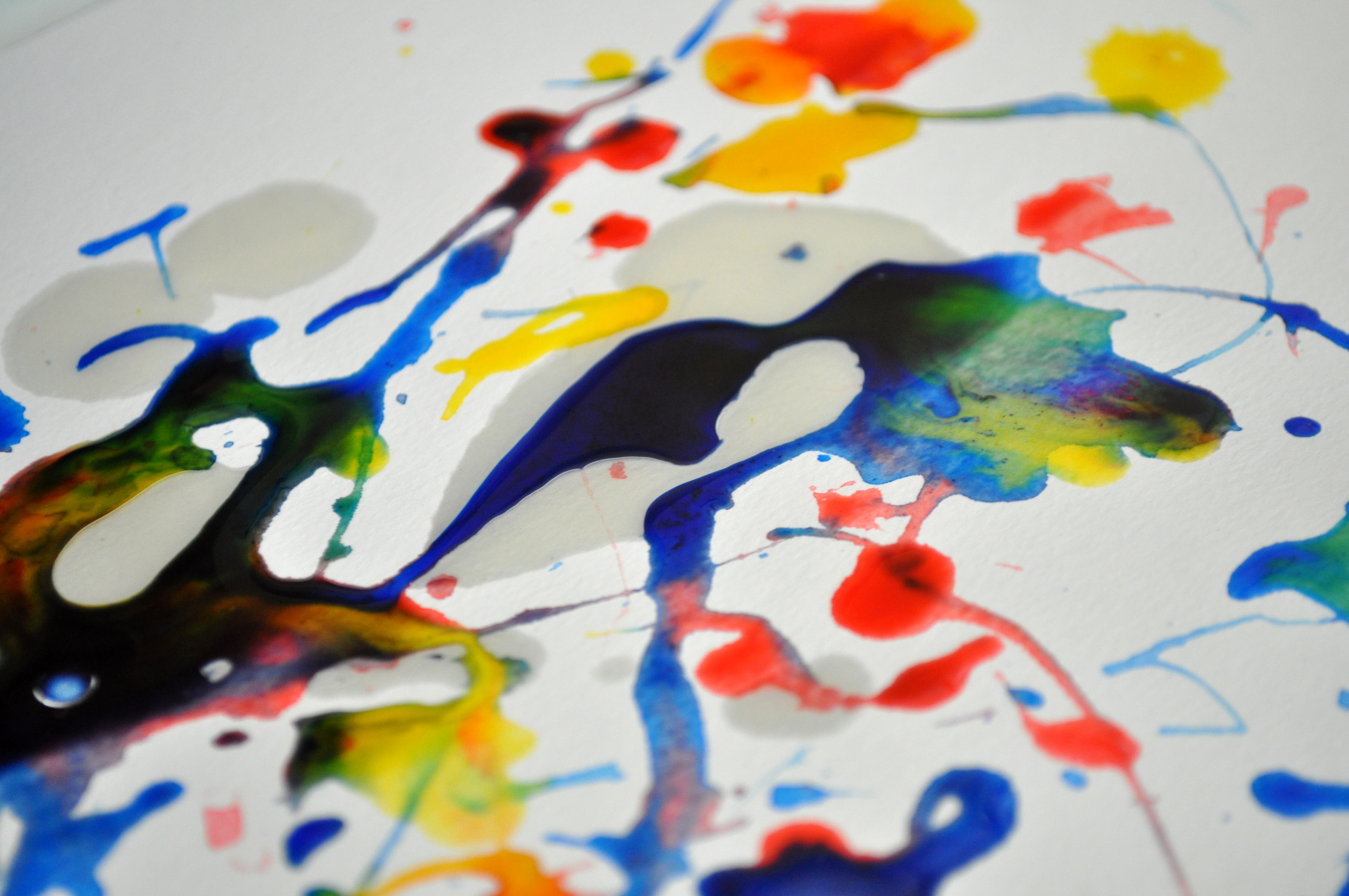
I’m a printmaker, so some of my favorite projects drew on printmaking concepts. The transfer of images is perhaps the most central concept in printmaking, and it’s really what made our paper marbling activity so surprising and exciting. For those unfamiliar with the medium, marbling is the process of creating designs by floating pigment on the surface of a liquid substance, like water or oil. When you gently press a substrate like paper or cloth to your colored surface, you’ll get a swirly, psychedelic transferred design. Here’s an accessible and kid-friendly interpretation of marbling that I found and adapted for AfterCare.
Materials:
containers with seal-able lids
shallow pans
vegetable oil
food coloring
forks, spoons, skewers
sturdy paper, such as card stock
In a few containers with tightly seal-able lids (mason jars work well), I combined about 1/4 cup vegetable oil with a generous amount of food coloring. I shook up my “dye” vigorously enough to get it looking pretty homogenous. When I arranged our workspace, I put down plenty of newspaper over two long tables, and then put our supplies in the center. I set out two rectangular cake pans filled about halfway with water, our jars of colored oil, spoons, forks, wooden skewers, and a stack of light-colored card stock. I knew this activity had the potential to be messy, so I put the marbling station in the center of the workspace so that kids could surround the materials from all sides, and then quickly transfer drippy paper to the newspaper at either side.
I had a few eager marblers right off the bat, and once we got going, more inquisitive kids joined us. I had them start by spooning drops of oil onto the water. For the sake of keeping our designs from getting too muddy, we had a pan for warm colors (orange and red) and cool colors (blue and green). After they had added enough for the surface to be fairly crowded with colorful blobs, we used the forks and skewers to stir the oil into swirly patterns. Then, one by one we each touched the card stock to the liquid for about three seconds. It was such fun to see the kids’ thrilled reactions to their beautiful marbled prints–their enthusiasm was palpable, and soon we had a quick-paced marbling factory running at the back of the classroom!
The kids were responding to one of the most captivating things about printmaking, which may be my favorite part of the process: the small moment of suspense before you see the print you just pulled. Will it be beautiful, weird, unexpected, perfect, or all of those things? It’s a joy to watch kids have that experience, and it’s a great reminder of why art education is so important.
For more information about The Art Studio Internship Program, CLICK HERE.
There’s still time to submit your caterpillars to our CALL FOR CATERPILLARS contest! CLICK HERE for more information and how you and your child can enter.
My last post was about how we made a window hanging out of old marker caps and other plastic tops by stringing them onto wire. I thought it would be fun to share one more of our window hanging ideas because I often get questions and interest from our visitors about the window screens we have created in The Studio. The Ribbon Window Shade uses some of the same materials as our Plastic Cap Window Screen and is a good way to explore the art of weaving. It also provides some shade during the sunny weather that should be on its way soon! Here is a list of supplies you will need to make a window weaving for yourself.
Materials:
Two tension rods that fit your window (We purchased ours at Target)
Duct tape to secure the rods
Colorful wire (We purchased ours at Home Depot)
Ribbons, strings, fabric strips, yarn or any other weaving material
First, you will want to put both tension rods in your window and secure them well so that they don’t move or shift when you start weaving. Our window is 58 inches wide and we hung the two rods 36 inches apart. I found that if you put some duct tape around the ends of the rods to attach them to the window they were much more stable and less likely to move once you begin wrapping the wire and weaving the ribbons.
The wire that we used is the same cable wire that was used for the Plastic Cap Window Screen. It is colorful cable wire that comes in a gray or black encasing which can be easily removed by peeling off the casing to reveal all the colorful wires. I suggest cutting the wire while still in the casing into lengths that are double your window length, at most. Otherwise the wire can get too long and tangles easily as you remove it from the casing. I began adding the warp (the vertical strands in a weaving) by looping the wire around the top and bottom rods. Secure the wire into place by wrapping the wire back onto itself. After you have added many lengths of wire this way then you are ready for the weaving part. I ended up doing 60 strands of wire to fill our window, but you may need to do more or less depending on the size of your window.
We have quite a collection of ribbons, strings, fabric strips, and yarn and I found that starting at the top with some of the wider ribbon works well to get the pattern started. To weave you should begin by pulling the ribbon OVER the first wire and UNDER the next and continue this pattern until you reach the other side (this back and forth pattern is done with the weft in a weaving). The alternating pattern will create a fabric-like weaving. And don’t be afraid to mix up your weaving a bit by going OVER two wires and UNDER the next one or making up any other weaving patterns you would like. Whenever you run out of one ribbon or string pick up a new one and keep going. I found that I could tuck some of the ribbon ends into place behind a wire but I also stapled a few together so they would be more secure. I liked adding some of the thinner string in front of the thicker ribbons so that there were a few layers on top of each other in the weaving. It is fun to experiment with whatever materials you are using to see how the textures and colors look with each other.
I hope you get to try out making your own window weaving and please take a look at our other window display tutorials like the ones below.
Here’s a sample of all the fun things guests are making in The Studio lately. The current Public Art Project is Animals in Motion, making moveable animal mobiles or puppets with chopsticks, coffee stirrers, paper card stock, wire and lots of fun furry and feathery materials. Above, Maiya and her mom made a few birds, and a rabbit that really hops! Below is a beautiful pair of galloping (Blue?) horses by two sisters.
Brown Bear, Brown Bear What Do You See?
A pair of friendly giraffes marching side by side…
One slithery, bejeweled snake…
And a few more feathery friends!
Animals in Motion runs now through April 9th, 2013, so stop by and make your favorite animal move.
**Don’t forget to enter The Carle’s Call for Caterpillars Contest for the chance to win an original doodle by Eric Carle! Visit www.carlemusuem.org/call_for_caterpillars for contest details. Submissions must be postmarked by May 31, 2013.**
In addition to giving a color-mixing watercolor demonstration, Melissa had the great idea to offer a mini kite workshop to celebrate spring!
Guests decorated colorful pieces of crepe paper, and after a few simple steps, many kites flew wildly on the patio and in the apple orchard. Fortunately, most of the snow from last week’s storm melted, the sun was shining and there was a nice steady breeze to guide the kites through the air.
We used the super easy kite tutorial from the blog Better in Bulk. Click here for the kite directions that worked like a charm. We added the streamer tail with construction flag tape and colorful plastic bags for some extra pizazz to the kite’s simple design.
After the kite workshop, guests gathered in the Reading Library to hear Melissa discuss her process, read her books, and even do some facial expression sketching exercises in mini sketchbooks. Melissa told us that for her newest book, A Splash of Red, in addition to working with watercolor and collage, she carved and painted pieces of wood to include in one of the illustrations of Horace’s paint brushes and pencils, how cool!
Below is large pop-up Melissa made from old posters attached to a folded piece of cardboard. She encouraged everyone to use materials around their own homes to make their own towns, jungles, or underwater habitats.
**Don’t forget to enter The Carle’s Call for Caterpillars Contest for the chance to win an original doodle by Eric Carle! Visit www.carlemusuem.org/call_for_caterpillars for contest details. Submissions must be postmarked by May 31, 2013.**
Tomorrow is the first day of the new Public Art Project, Animals in Motion, where we invite you to create a moveable animal mobile of your favorite creature. It’s inspired by the exhibition The Art of Eric Carle: Feathers, Fins and Fur, opening Tuesday, March 12th in our West Gallery.
The video above is an inspiring glimpse into the world of large-scale kinetic sculpture. In 2008 The Atlanta Botanical Gardens featured an outdoor exhibition of 16 kinetic sculpture artists displaying their large moveable sculptures around the gardens. This video, created by PBA30 Atlanta’s PBS station, features the kinetic artists: Tim Prentice, Zachary Coffin, Kristina Lucas, George Sherwood, David Fried, and Susan Pascal Beran. Which sculpture is your favorite?
Inspired to create a mobile at home?
Click here for a very sweet and thorough video tutorial by Big Red Hat Kids on how to make an Alexander Calder inspired sculpture from wooden dowels and air-dry clay.
Click Here for a tutorial by Blick Art Materials on how to make a kinetic Dura-Lar mobile.
For more videos like the one above, search “kinetic sculpture” on YouTube.
I hope to share some photos of visitors’ animal mobiles in my next post, so stay tuned!
Don’t forget to enter The Carle’s Call for Caterpillars Contest for the chance to win an original doodle by Eric Carle! Visit www.carlemusuem.org/call_for_caterpillars for contest details.
Hi! I’m Sarah Johnston and I work part-time in the Studio and conduct Student Outreach Programs for The Carle. Diana and Meghan invited me to contribute to the Studio’s blog about once a month, so I’m excited to start sharing some of my ideas with you. I have a background in art education and taught elementary art for five years in Chicago before relocating to Western Massachusetts with my husband in 2011. I hope you enjoy my first post!
There is something very magical about making the first footprints, snow angels or other marks in a fresh blanket of snow. It often makes me think of a blank canvas just waiting for an artwork to emerge. This project captures that magic in a slightly different and more colorful way. The materials you need to snow paint are ones that you most likely have in your home already, even if you are snowbound. So if your family is looking for something different to do in the snow, give snow painting a try.
The Materials:
Condiment style bottles (we purchased ours from Target)
Food coloring and/or old and dried out markers
Snow!
Part of the fun is mixing up different colors of “paint” into your bottles. I found that about 4-5 drops of food coloring in around 6 oz. of water will give you bright enough colors. The process of making the paint could even be used as a quick lesson in color mixing and discovery. As a former art teacher I often looked for ways in which children could discover on their own how colors mixed to form new colors. The food coloring box may only give you some of the colors in the rainbow so you might have to mix the other colors. What happens when you add a drop or two of red into yellow? What colors do you think you need to mix to make purple?
If you don’t have food coloring in your kitchen I found another way to make quick and easy “paint” when we were purging the Studio’s marker collection. Older and dried out markers may not have enough color to draw with anymore, but if you drop one or two markers into your bottles with water then you will have some other vibrant colors to paint with. Once your colors are mixed up it’s time to go outside and try painting on the snow. The bottles should give enough control to write, draw or just spatter like Jackson Pollock.
Have you used old markers successfully in art projects? I’m always looking for ways to reuse regularly discarded materials, so I’m going to continue exploring the possibilities of reusing old markers. Hopefully I’ll share with you my findings!
Don’t forget to enter The Carle’s Call for Caterpillars Contest for the chance to win an original doodle by Eric Carle! Visit www.carlemusuem.org/call_for_caterpillars for contest details.
To celebrate The Eric Carle Museum of Picture Book Art’s 10th anniversary year, we invite friends, families, schools, and other organizations throughout the country and abroad to create 3-dimensional caterpillar sculptures out of found materials. Be inspired by Eric Carle’s most beloved character, The Very Hungry Caterpillar, and transform ANY combination of recycled or found materials (plastic, paper, foam, wood, metal, etc.) into a 3-dimensional caterpillar sculpture. Photographs of the caterpillar sculptures will be displayed at The Carle and on The Carle’s Facebook, Twitter, Pinterest and homepage.
What You Could Win:
Three entries will be chosen at random at the Museum’s Children’s Book Festival on June 8, 2013 and will receive an original doodle by Eric Carle!
How to Enter:
Have fun creating your caterpillar either as an individual or part of a group.
Submit up to four digital images of your sculpture. These photos can be of the various stages of fabrication or of the completed caterpillar taken from different angles. Photos should be high-quality .jpg images, no larger than 2MB.Please do not send original artwork!
With each submission, please provide artist(s) name(s), a daytime phone number, email address and mailing address of the primary contact. Primary contact must be 18 or older.
If you are sending multiple entries please put photos of each submission in a separate folder on the CD.
How to send us your digital images:
Mail images on a CD to: Call For Caterpillars, The Carle, 125 West Bay Road Amherst, MA 01002
Email images as attachments to: callforcaterpillars@carlemuseum.org (see above for photo size guidelines)
Submissions must be postmarked by May 31, 2013. Pictures of the sculptures will be
displayed at the Museum either on a digital picture frame or printed and displayed in the Art
Studio from June through August 2013.
Submitted photos may be featured on The Carle’s social media pages, website or print
publications. Photos become the property of The Eric Carle Museum of Picture Book Art
and will not be returned.
To print out a PDF of the contest flyer, including guidelines and rules, click here!
For more information visit www.carlemuseum.org/Call_for_Caterpillarsor email callforcaterpillars@carlemuseum.org
Stay tuned for future posts about this contest. We hope to see your caterpillars very soon!
Reid, our January-Term intern, designed and hosted a really fun special Studio activity last week for Museum guests. Here is her report on the planning process of the project and her reflection on the day.
When brainstorming for my Special Sunday activity, I knew right off that I wanted to experiment with the way we use light to make images. In the studio, our large windows provide so much beautiful natural light, and I wanted to utilize this feature in the activity. Meghan and I were bouncing activity ideas off each other when we came up with the idea of tracing shadows. Upon further elaboration we came up with the idea of using found objects to make shadow collages, tracing the lines, and finally painting over the drawn images. Initially I was having trouble deciding between collaging and painting, and this project combined the two!
Once I knew what I wanted to do, I began to plan out what materials we would use. I played with different kinds of drawing tools, paints, and paper to find the perfect combination of supplies. In the end, I decided to use Staonal crayons with tempera cake paints on large pieces of watercolor paper. I found the paint appeared bold and bright on the paper and didn’t smudge the Staonal, so the tracings remained intact.
We put out baskets of found and natural objects that would cast interesting shadows. Each visitor could choose up to 4 objects at a time, and when they were done with those they could trade them back in for different pieces to trace. We had natural objects like stones, pinecones, and seashells, along with found objects like ribbon, bottle caps, and mesh. It was important to have a variety of different shapes and sizes available.
On the day of the project we were lucky enough to have gorgeous sunny weather. Of course, because of New England’s unpredictable weather, we were prepared to use an overhead projector as a back-up plan in case the sun wasn’t out. We arranged the back of the art studio so that the tables were pushed to the right side; this area was set up as the painting area, complete with paintbrushes, water, sponges, and of course paint!
The left side of the studio was the tracing area. This is where visitors would put down their paper on the floor or sit on a chair and trace on a stool to arrange their objects and trace the shadows. We had cool shades that had previously been crafted by staff members on the windows already, and we moved these so there could be some interesting shadow patterns on the floors for the visitors.
The cool thing about this project was it could be as complicated or as simple as you want it to be, depending on age level, ability, and interest. I didn’t want something where the guidelines were super stringent. If a child didn’t want to draw on the floor, they could just paint at the table. I made sure to emphasize that when talking to the visitors. There were no rules to this project; the point of it was to allow the materials and the environment to inspire and to create.
I would say this project was definitely a success. It was exciting to see the families collaborating with each other and having fun with each other’s work. This activity was able to engage visitors of all ages. I was delighted to see how creative the children (and adults!) were with this project. Some visitors were very abstract with the images they made, while others used the shadows to create scenes out of their objects. All in all, it was a very fun afternoon in the art studio!
There are a few new additions to The Studio recently! We have an over-sized print from the last page of Eric Carle’s The Very Hungry Caterpillar hanging on our back wall.
As you can see, it makes a fabulous photo-op for kids or adults! (As Studio staff members Megan and Sabrina demonstrate above)
In honor of the newest exhibition Some Book! Some Art!: Selected Drawing by Garth Williams for Charlotte’s WebSabrina and Megan wove a Charlotte-like web on our front wall.
Using references from E.B. White’s Charlotte’s Web and Eric Carle’s The Very Busy Spider they pinned pieces of yarn in place on the board and completed it with the special message in the middle
Stop by The Carle this week to see the beautiful Charlotte’s Web exhibit in the Central Gallery and then pop in the Studio to weave your own 2D or 3D web using colorful strips of paper, glue, tape and staplers. You remember the clever catchphrase SOME PIG! Charlotte wove into the web above Wilbur’s pen? Well this project is called Some Weaving! and just like a spider web it won’t last forever, so hurry over and weave webs with us!
I promised some ideas for making greeting/holiday cards with kids. Here is one which will require a little prep and assistance from an adult since it calls for a specialty material and the use of an iron.
First, see what you have for fabric. Scrapish pieces will do. The bottom half of the tee shirt that ripped and a piece of the skirt with the stain on it will do. You might like to start with 3 different fabrics/colors, each somewhere around 12″x12″ but smaller will work too.
You’ll also need some double-sided fusible web from the fabric store. Pellon is one brand that makes some, but other brands work too. Ask for help at the store if you don’t’ know what you’re looking for. 1/3 yard will be enough to make a bunch of cards.
Then, iron the wrong side of the fabric to the fusible web according to the directions it came with. Here’s a tip from someone who learned the hard way: DO NOT touch your hot iron directly to the exposed web or you will get icky stuff on it. You’ll be fine if you trim your fusible web to be just smaller than the piece of fabric you are attaching to it. Since you’re likely using multiple fabrics/colors, you’ll be cutting it anyway.
When the fabric you fave fused to the web is cool, you and your young person are ready to cut it into shapes. If you don’t know what shapes to cut out, just take your scissors for a walk across the fabric and see what you get. The negative or left-behind shapes are usable too!
Next, peel the fusible web backing from your shapes and arrange them on a piece of folded cardstock. You could also arrange the shapes on a differnt piece of heavy paper that you glue to a card later.
Turn the iron back on and carefully iron your shapes to the paper with medium heat, no steam. You can use a thin cotton cloth over the shapes and card as you press if you want to be certain your iron stays safe from icky stuff.
Alternatively, instead of using double-sided fusible web, you could iron your fabric to single or double-sided fusible stabilizer and glue the shapes rather than iron them to your card. The stabilizer adds some dimension to the shapes but if its too thick, you can’t iron your shapes to the paper because the heat won’t pass through it enough to activate the sticky part.
When your shapes are ironed/glued down your card is ready for a message!
“Well, why not just glue fabric directly to the card and skip all the work,” you ask? You could, but sometimes the amount of glue required to glue fabric down warps the paper underneath. And, maybe you’ve noticed how the texture and color of fabric changes after its been soaked through with glue? With fusible web or stabilizer, the fabric still looks and feels like fabric when you’re done.
I wish I could take the credit for these great ideas, but I can’t. Diana first found the fusible web idea in this pretty book and she came up with the stabilizer variation for her Handmade Cards and Books workshop for teachers.
In The Art Studio Latin Landscapes April 10 - May 21, 2013 Free with Museum Admission Capture the beauty of the landscapes from Latino Folk Tales: Cuentos Populares–Art by Latino Artists and create a picturesque panorama adapting the textured drawing style of illustrator Raul Colón.