Archive for the ‘Activities’ Category

New Public Art Project: FACE IT

Tuesday, November 13th, 2012

Last week a local school group of first graders got a sneak peek of the new Public Art Project Face It, and made lots of creative portraits with a selection of colorful collage papers in warm and cool colors.   Here are a few of some of the great faces the kids created.

This one has big green eyes…

This guy wears glasses and is sticking out his tongue…

and this one sported multicolored pigtails and a big blue smile!

The children’s special trip to The Carle also included a tour of the art galleries and a private showing of  Picture Book Theatre’s adaptation production of Eric Carle’s The Very Quiet Cricket and The Very Lonely Firefly, featuring beautiful puppets and talented young dancers in the cast.

If you’re in the area one of the next few weekends stop in the Studio to make a face and catch the show too!  Picture Book Theatre have shows on Saturday Nov 17th, Friday Nov 23rd,  and Saturday Nov 24th at 2:00 pm and 3:00 pm.  Tickets are $5 each and may be purchased in advance at the Museum Admissions Desk or by calling (413) 658-1126.

I’ll post more faces soon!


Susan Schwake’s Monster Mash Workshop

Monday, October 22nd, 2012

Just in time for Halloween, the Art Studio came alive with creepy, crawly, hairy, spiky creations in yesterday afternoon’s Special Sunday Monster Mash Workshop.   We were very excited to host artist, educator and author Susan Schwake for the day in the back of the Studio, where she lead the workshop and signed guests’ copies of her amazing new book, Art Lab For Kids  (available for sale in The Carle Bookshop).

Susan runs a gallery/studio/art academy called Artstream Studios in Rochester, New Hampshire, where she’s been teaching art to children and adults since 1993.  She describes the book as a collection of all the successful art lessons she’s taught over the years.

Artist and Author, Susan Schwake

The Texture Monster activity is just one of many drawing, painting, printmaking, paper and mixed media lessons featured in the book.  Susan’s husband, Rainer Schwake took the beautiful photographs of the step-by-step process of each lesson.  It would make a great gift for the young artist in your life and I highly recommend it for any parent or educator looking for fresh ideas.

If you’d like to make your own Texture Monsters like the ones we made in yesterday’s workshop, you’ll need cover weight paper (we used 11″x17″ white) and wax crayons or oil pastels in different colors for doing the rubbings.  You could use store-bought or homemade rubbing plates for this part.

Next, use watercolors to fill in the paper with areas of color.  The wax or oil will resist the watercolor paint, creating a neat effect.  Allow the paper to dry completely before cutting or tearing out shapes for your monsters.

Use a large sheet of sturdy paper a the support for your texture monster collage.  We used 12″x18″ sheets of construction paper and guests chose from black, pink, yellow or blue as the backgrounds.  Use your imagination to arrange your shapes to make friendly (or scary) monster characters.  Making monsters is great activity for a family Halloween party or and would make festive home or classroom decorations.  Art Lab For Kids suggests taking this activity a step further by making monster birthday or get well cards.

Susan has a few more books in the works which sound pretty exciting and we look forward to having her back for another fun workshop in the future!  You can follow Susan Schwake on her blog Art Esprit , her website SusanSchwake.com and purchase a signed copy of her book in the Carle Bookshop or here.


Photo credit: Studio Intern, Gabby Rosenberg

Leafy Critter Books

Wednesday, October 10th, 2012

I’m pinning up a storm over on The Carle’s Pinterest boards getting ready for my nature workshop this Sunday. My favorite board to pin to, Bridging Art and Nature, is a growing archive of inspiring ways to experiment with, appreciate and observe nature together at home or with students in an artistic way.

One of the popular ideas I see floating around Pinterest right now is using fall foliage to create little leafy critters. Here are a couple of my favorite, most inspiring versions:

kokokoKIDS: Fall Leaves Craft Ideas

Leaf Critters via Little Emma English Home Blog

Leaf Alphabet via Martha Stewart.com via Apartment Therapy

At the end of the summer this year we did our own version of this activity with leaves and flowers collected from The Carle’s grounds and a nearby farm.  We pressed them for a few days between sheets of tracing paper and corrugated cardboard under the weight of heavy books.

Students selected which leaves and flowers they wanted from the trays and used Aleene’s Tacky Glue to attach them to pieces of white mat board.

When the covers were completely dry, we made enough photocopies of each child’s image so everyone would get to take home a book full of everyone’s critters.  The next day we helped the students bind their books with the Stick-and-Rubber Band binding method.  We used a 2-hole punch, sticks collected and trimmed, and rubber bands to bind the books.

If you don’t have the time to press leaves ahead of time, we’ve also created natural book covers with non-pressed leaves and flowers, and the outcomes were just as beautiful.

Let us know if you give this project a try or design your own version!

Follow The Carle’s growing Pinterest Boards! Bridging Art and Nature, Making Art with Children, Art Activities and Explorations, and Programs and Events.

Show Me a Story with Emily Neuburger

Monday, October 1st, 2012

On Sunday, September 23rd, the Studio had a special guest for this month’s Special Sunday activity!  Local artist, author and teacher Emily Neuburger stopped by for the afternoon to share a fabulous activity from her new book, Show Me A Story.  Emily helped many enthusiastic guests make their own set of cards  illustrating a favorite memory or imaginary story.    In the photo above you can see several beautiful cards Emily brought along to inspire guests with this project.

We used vibrant origami, construction and magazine papers.  Guests drew and cut out shapes, then glued them to the 3″ x 4″ chipboard rectangles.  In her book, Emily encourages you to reuse what you already have, to try this activity at home cut the cards from old cereal or cracker boxes.

The Studio buzzed with activity all afternoon!

Young guests illustrated really great stories, real and imaginary.


Some people worked independently…

…and others worked together.

Here’s Emily’s daughter making a memory card with her grandmother :)

After all of the collage pieces were glued down, Emily showed guests how to brush a layer of  acrylic medium over the top of the card to seal and protect the image.  Emily recommends using Mod Podge, available at craft stores.

The final step was to leave the memory cards to dry for a little while.

Below is a small sample of some of the finished cards created by guests of all ages!

For more information about Emily Neuburger, follow her blog, Red Bird Crafts or check out her new book Show Me a Story, in The Carle Bookshop or wherever books are sold.

Thanks for visiting, Emily!

How to Make Paper

Thursday, September 13th, 2012

A few weeks ago, the Studio hosted our annual full-day summer class for children, Animals, Art & Imagination.  It’s one of my favorite weeks of the summer because of the range of art activities we get to do with the kids in the Museum and outdoors at The Hampshire College Farm.  Meghan posted about the program last year, you can read her post here.

One of the morning activities we added to the four-day program this year was making paper! We blended cotton rag and natural fiber pulps with fresh leaves, petals and seeds.  I purchased the cotton rag pulps, natural fiber pulps, reusable couch sheets,  and the Arnold Grummer’s Classroom set of Hand Molds from Nasco Arts & Crafts catalog. The classroom kit includes a set of 6 mold sets, which was plenty for us.  The other supplies: blender, sponges, containers and trays we already had on hand.

First, I talked about the history of papermaking, where paper comes from, and passed around sheets of handmade paper and dry pulp for everyone to feel.

I went through each of the papermaking steps, turning the blended mash into a finished, pressed sheet of paper.  For this activity I showed them the pour method, where the pulp and water mix is poured over the mold.  The dip method is another way; you scoop the frame into a large tub of the watery pulp mix and pull it up, collecting the fibers on top of the screen and letting the water drain out the bottom.   I chose the pour method because it’s easy to make as many sheets of paper as you need without any waste. I think it’s best for working in smaller groups or in indoor spaces where it’s not an option get the space very wet.

I took papermaking in college, and the lab was designed with water drains built into the painted concrete floor and we had to wear rubber boots to keep our feet dry and prevent slipping on all the dripping water.  Needless to say, papermaking is a very wet (but fun) media!

When it was the students’ turn to make paper, the children eagerly picked from the flowers, plants and seeds (collected from a nearby farm) and mixed them with the cotton rag and natural fiber pulps in apple sauce to-go cups (any yogurt or small plastic cup would also work).

1/2 a cup of dry pulp = One sheet of 5.5″ x 8.5″ paper.

As you can see,  no two sheets of paper were alike!

I put the blender at a big table so everyone could watch each other blend the pulp while they waited for their turn.  You want plenty of water mixed with the pulp (we used about 3 cups) to help distribute the pulp evenly over the paper mold and keep it from clumping.  Because the pulp was purchased pre-shredded, it only needed to be blended for about 10 seconds on low.

I assisted with pouring the pulp mix over the mold & deckle to make sure the pulp spread evenly across the mold.  The oldest children poured the pulp themselves.

After removing the deckle, the wooden frame that helps give the sheet its form, we put a piece of screen on top of the pulp (it comes with the class kit) and used a large sponge to absorb as much water as possible, ringing out the sponge between presses.  It’s hard to see in these photos, but the blue mold is sitting on top of a white plastic grid that came in the classroom kit, which helped give the mold its structure and made the water drain more quickly.

With most of the water drawn out by the sponge, the pulp sheet was transferred from the mold onto a couch sheet (very absorbent paper or material designed to draw any remaining water from the paper without sticking to the wet pulp). Anna helped them press out any additional water.

The next morning, the kids proudly showed their parents the paper we left drying on trays overnight. All of the paper sheets were completely dry and ready to bring home by that afternoon.

For this activity we worked with a group of twelve children, ages 6-10, and I had an assistant, Anna, helping me supervise the stations.  It would have been very tricky to supervise everything myself.  If I did papermaking with a larger group of children (classroom size), I would pre-blend the pulp in large buckets that we could scoop from and pour over the molds, instead of using the blender.  The children could still make their paper unique and colorful by adding petals, leaves or seeds between poured the layers of pulp.

I’m by no means a papermaking expert, but having some previous experience from college made me more confident with trying papermaking with a multi-ages class.  I would recommend testing out all of the steps yourself a few times and watched some videos online to see the different variations.

Participants in my upcoming Fall Workshop will also get a chance to experiment with hand papermaking:

Bridging Art and Nature for Teachers and Parents

Sunday, October 14, 2012
10:00 am – 3:00 pm
$60 (Members $55)
(5 PDPs) Using some of our favorite picture books and our beautiful surrounds, we will explore ways to link the art and design of the picture book with an exploration of the natural world and a variety of open-ended art projects. Designed to enhance your science curriculum or provide ways to share outdoor time with your children, the program includes time spent outside, so please dress accordingly. We also suggest you bring a brown bag lunch in order to maximize workshop time.
Instructor: Diana MacKenzie.  To Register for Professional Development Workshops at The Carle, click here

If you want to learn more about how to make paper, I encourage you to do some research, take a class, or watch some demonstrations of the pour and dip methods online.  Below are a few quick videos that I found helpful:

Here’s a 4th grade teacher demonstrating the dip method to his class.

Here’s a version of the pour method by PaperStudio.com

Here’s how they make paper in Nepal from the Lokta plant.

Have you ever made paper at home or in your classroom? Which techniques worked best for you?

Photo Credit  Laurie Mills

Aiyi’s Special Sunday: Veggie Printing

Thursday, August 23rd, 2012

Last Sunday, our intern Aiyi hosted a Special Sunday project in the Art Studio. Together, we sat down to write about how it went, from her point of view:

Special Sunday at The Eric Carle Museum

When I was asked to design a Special Sunday project, I first thought about how I do my own art. Sometimes it’s hard to explain what my work is about, since what I’m doing is just playing with the color, shape, and the texture of materials. I wanted the Museum guests to have as much fun with materials as I do.

You may have done veggie printing at home or school before, but for a Special Sunday we prepare for around 60 people to be able to participate. That means that the project design has a lot to do with how we set up the materials and space.

Special Sunday at The Eric Carle Museum

After talking with Diana and Meghan, I decided to assign a color to each type of veggie (we used tempera paint) and give each color/veggie combo its own table. Color mixing is fun, but if we placed the colors close together, the crossing of veggie stamps would mix all the colors to brown pretty quickly.

The veggies we used for this project: broccoli, brussels sprouts, celery, white mushrooms and bell peppers.  I cut all of the veggies in half and visitors printed with the flat side, producing a range of marks in the paint. People discovered many techniques for using these common materials. Some used the veggies to print, some to brush, and some mixed colors.   Many liked the sound of the veggies dropping on the table.

Special Sunday at The Eric Carle Museum

Some created a landscape, one created an image of flower in a vase, and others were abstract. I think the project attracted kids that don’t love making art because it was just about playing with materials.

Special Sunday at The Eric Carle Museum

A few things we tried that were successful: providing paper in long strips and squares encouraged pattern making; pulling the chairs away encouraged movement; adding a tray of blue paint containing all the veggies offered a variation of shapes with just one color.

If I have an opportunity to do this again, I would like to experiment with using natural material as paint, to make the experience closer to nature. I would also like to try bringing fruit into this project.

So, now that farm share season is in full swing, take out the paint and get printing!

Fun Facts

Monday, August 6th, 2012

We’re busy making Tissue Paper Collages in the Art Studio again! This is probably the most popular project we do all year.  Below are a couple fun facts about the materials we use during a typical Summer Public Art Project.

·       Museum guests create over 3,000 tissue paper collages in the Art Studio during the 6-week program.

·       We go through nearly 9 gallons of liquid starch glue for making collages (the average collage requires less than 1-ounce to stick together!).

·       If we lined all of the collages up side by side, they would stretch for 2/3 of a mile!

For more information about making a tissue paper collage at home or in the classroom, visit our Activities web page and click on “Tissue Paper Collage,”  “Watercolor Tissue Papers” or “Homemade Liquid Starch Glue.

Here are a few of our blog posts about tissue paper collaging:

Intergenerational Collage Activity

Watercolor Paper 101

Watercolor Wash Collage Papers

This project ends on August 13th, so be sure to stop by before then to make your own!

Laurie’s Special Sunday: Inkblot Creatures

Thursday, July 26th, 2012

Laurie, one of our summer interns, hosted a special Studio activity last week. Here is her report of the day:

This month’s Special Sunday  was my opportunity to design a project that all ages could enjoy and explore. I realized how tricky it was to come up with an idea that not only allowed as much freedom as possible, but also encouraged  our guests to be imaginative. After  discussing a few ideas with Diana, we finally came up with Inkblot Creatures. I was inspired by the famous Rorschach Tests, which are symmetrical inkblots used to study people’s personality characteristics when they report the images they see in the forms.

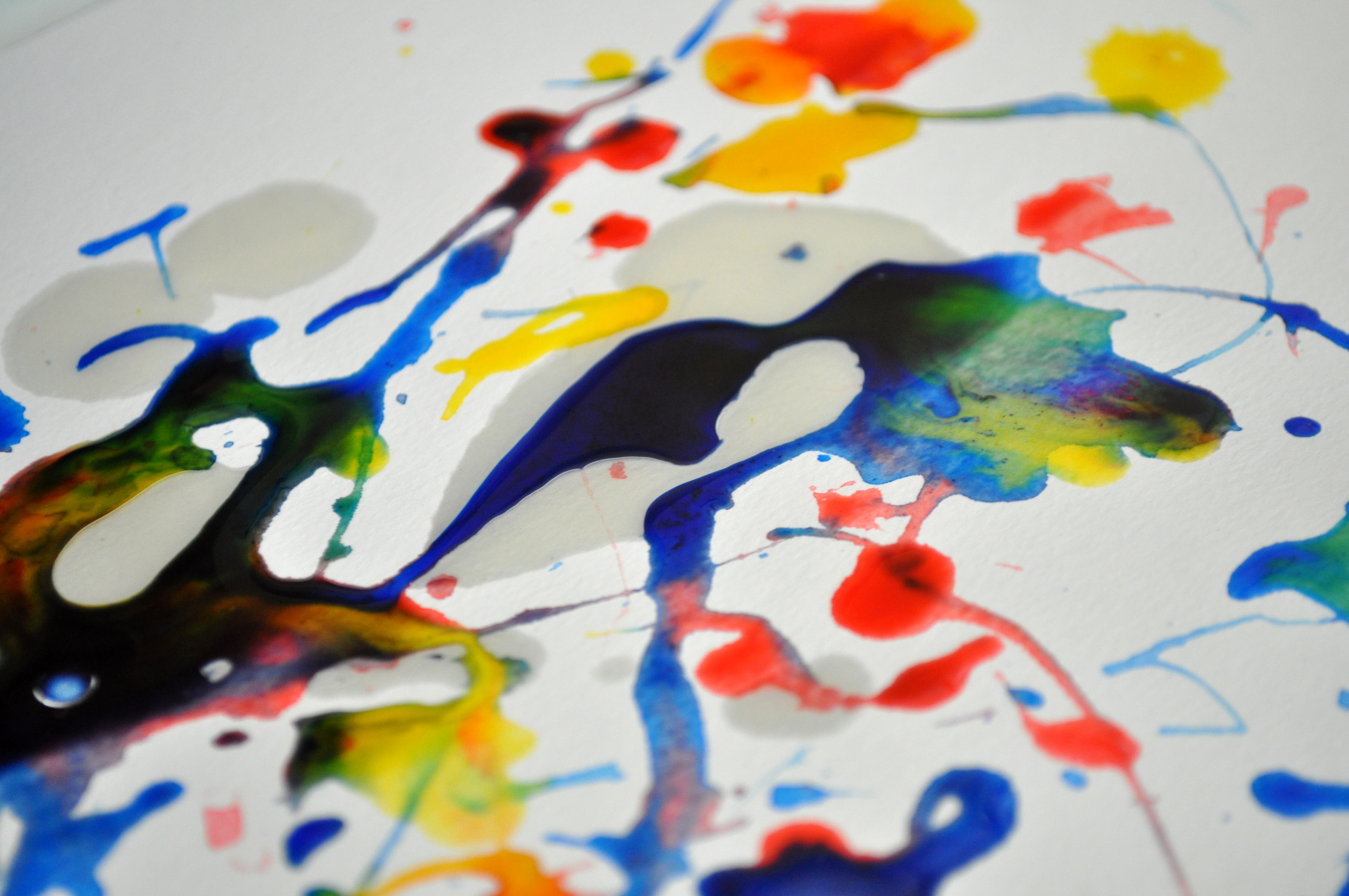
The paint we used for this project was liquid watercolors, which worked well for a few reasons: they dry relatively quickly (when used moderately), they can be drawn on with watercolor crayons, and the colors bleed together quite beautifully.

To create an inkblot creature, I invited guests to put a few drops of each color on their paper, fold it in half along a center crease, then press and rub all around the folded paper. When they opened it back up, the paint had squished and spread into an interesting and colorful form!

After thinking for a few moments and turning their paper to get different views, guests used their imagination to draw in the rest of the creature with a black watercolor crayon. Some guests were inspired to see things besides creatures, like tree bark, a sunset, or a princess in their work too.

I prepared watercolor paper by pre-folding it so there would be a crease down the middle. I also mounted it on larger black paper, which gave it a frame but also allowed room for the paint to bleed onto if it went off the sides of the white.

At first I put the paints in a shallow dish, but I noticed that sometimes a guest was tempted to use ALL of it at once, so I tried using a smaller cap to  encourage using an amount of paint that made sense for the size of the paper. The project works best when you start off with a little paint, then build on and add more as you go. I only put out red, yellow, and blue so beautiful secondary colors would appear when the paint bled together.

This project is really fun to create because the product is surprising and inspires the imagination. It’s also a good lesson on symmetry! The next Special Sunday project is August 12th, so be sure to stop in!

-Laurie

Materials Play – Leaf and Flower Collages

Friday, July 13th, 2012

Materials Play at The Eric Carle Museum: leaf collage on contact paper

Today  kicked off our summer session of Materials Play in the Morning – a weekly drop-in activity for especially for toddlers. Aiyi has been helping me plan the activities. We have many fund ideas, so its hard to choose!

Materials Play at The Eric Carle Museum: leaf collage on contact paper

Since the orchard is awash with greenery of all kinds, we thought we’d try an idea I’ve seen on Pinterest using leaves and petals to create a collage on contact paper.

We happen to have a narrow roll of lightweight contact film that was donated to us. I think a heavier contact paper- like the kind you can find in the shelf liner section of the dollar store-  would have been better.

We prepped the contact paper by cutting it into trips twice as long as we thought the finished collages should be.

Materials Play at The Eric Carle Museum: table setup for leaf collages

Then, placing a sheet film side down/paper side up on the short table and light table, I peeled back the paper to expose half, sticky side up.  I used some painter’s tape to secure the strip to the table so it wouldn’t shift as the kids worked. Next time I might trim the flap of paper that was left, but I just taped that down too.  I also taped a few pieces to the window.

Materials Play at The Eric Carle Museum: table setup for leaf collages

A few children were interested in dumping petals and leaves on their sticky surface. One girl just liked pressing her hands and petals on the paper and taking them off again. If I were doing this with a class I would definitely have the students collect their own petals and leaves but I’d also have a few items I’d collect ahead of time.

When the children were done with their arrangement I peeled the rest of the paper off and folded the newly exposed half of the contact paper onto it. The kids then pressed their arrangement together and I told them to look at their collage over the next few days to see how it changes.

Materials Play at The Eric Carle Museum: leaf collage on contact paper

This program is for the half hour before the 10:30 storytime in the reading library, so this is as far as we took it.  When/if I do something like this with older children I might have them draw a large shape on a piece of white paper to slide under the contact paper so they could arrange their leaves and flowers in a shape they’d like to cut their contact paper into later.

And, speaking of storytime: to help the participants make further connections with the materials we used, Abigail included some books in a gardern/leaf theme in storytime directly after: Leaf Man by Lois Elhert’s, Ava’s Poppy by Marcus Pfister, What If Everything Had Legs by Scott Menchin, and We’re Rabbits written by Lisa Westberg Peters, Illustrated by Jeff Mack. She didn’t get around to it, but My Garden by Kevin Henkes would have been a great one too.

If you find yourself in the care of a toddler on a Friday morning between now and the end of August, stop on by at 10 am in the Studio! (Details here.) Next week’s materials: pasta and paint.


Drawing Day

Thursday, April 26th, 2012

I wanted to share some photos from last Sunday of one of my favorite events, Drawing Day in The Art Studio.  The Carle devotes one Sunday every spring to scribbles, doodles, designs, paintings, cartoons, traces and sketches.  For Drawing Day this year we brought out some of our most popular drawing tools and divided the room into six different stations for visitors to work with the materials in an  independent, open-ended way.

Thanks to a generous donation from the paper company Canson, Inc., each visitor received a free sketchpad to use at the different stations and to continue their drawing discoveries at home.  Thank you Canson!

At the “Make Your Mark” station visitors scribbled and rubbed different textured rubbing plates onto their papers with colorful crayons.  For a similar activity you can do at home, visit the Web Activities page on our website or click here for the printable PDF.

At the “Free Draw” station some experimented with drawing without looking (or contour drawing) by wearing our funky “blindfold” sunglasses.  We made the blindfolds from a pack of party glasses from Oriental Trading Company.  Pop out the lenses, paint them with a few coats of black acrylic or gesso, let them dry, and pop them back in place and you’ve got a blindfold!  These are a great alternative to cloth blindfolds for a classroom or party.

When you can’t see what your hand is doing, what you think  you are drawing is often quite different from what you actually draw!  It’s a fun challenge, try it the next time you’re drawing at home.

Here’s a photo of visitors making 3D  wire “drawing” sculptures.

The thumbprint cartoon station and the watercolor station were the most popular tables of the day and visitors filled their new sketchpads with brightly colored doodles, marks and cartoons.

Also on Sunday,  author and illustrator Durga Bernhard shared a few of her books at a special storytime in the Reading Library.

Afterwards, Durga joined us in The Studio to meet with visitors and give them a a chance to see her drawing process.  Durga and her friend came up with a delightful caption to the illustration she hung up on our back wall.  She drew “A long-tailed firebird who stole a fish from the octopus.”  Stop by The Studio this weekend to see Durga’s beautiful drawing.   Thank you for joining us Durga!

For more information about Durga Burnard visit her blog, click here.

For a link to some of the Canson paper products we sell in The Museum Shop, click here.