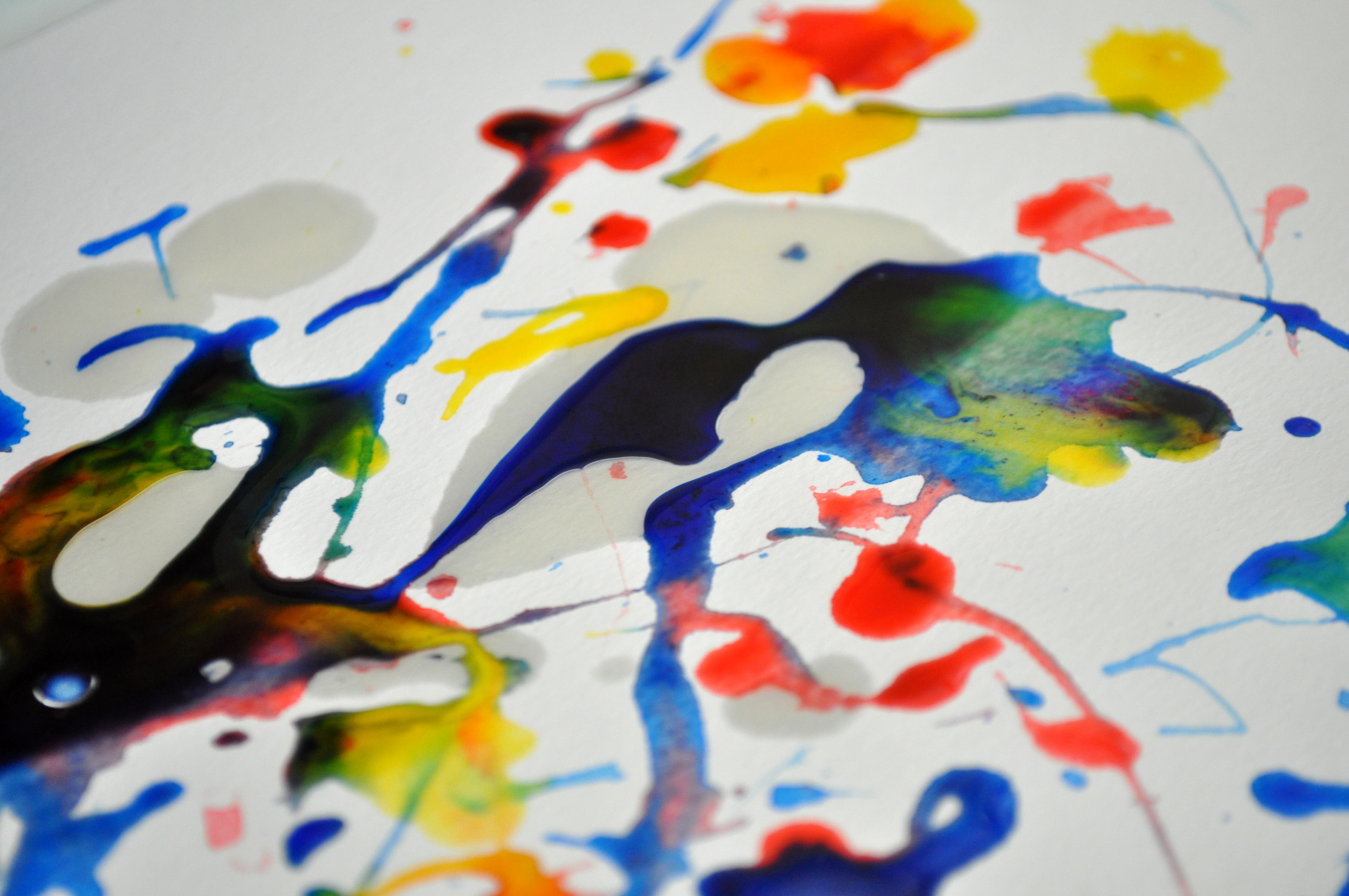
Hey! We just realized we’ve shared 100 posts since we started this blog last June. To celebrate, I’d like to share some a small percentage of the many beautiful things made in the Studio since then . These images represent ideas, problems solved and not-yet-solved, imagination, experimentation, conversations shared, and yet more work which wasn’t kept by the creator but was still worthy of creation nonetheless. For those of you who have started or are about to start a new school year next week, I hope these images help you begin the year on a happy note. Enjoy the weekend and here’s to the next 100 posts!
Making Art with Children
Archive for the ‘Infants & Toddlers’ Category
One Hundred (and One!) Posts!
Friday, August 31st, 2012Materials Play – Leaf and Flower Collages
Friday, July 13th, 2012Today kicked off our summer session of Materials Play in the Morning – a weekly drop-in activity for especially for toddlers. Aiyi has been helping me plan the activities. We have many fund ideas, so its hard to choose!
Since the orchard is awash with greenery of all kinds, we thought we’d try an idea I’ve seen on Pinterest using leaves and petals to create a collage on contact paper.
We happen to have a narrow roll of lightweight contact film that was donated to us. I think a heavier contact paper- like the kind you can find in the shelf liner section of the dollar store- would have been better.
We prepped the contact paper by cutting it into trips twice as long as we thought the finished collages should be.
Then, placing a sheet film side down/paper side up on the short table and light table, I peeled back the paper to expose half, sticky side up. I used some painter’s tape to secure the strip to the table so it wouldn’t shift as the kids worked. Next time I might trim the flap of paper that was left, but I just taped that down too. I also taped a few pieces to the window.
A few children were interested in dumping petals and leaves on their sticky surface. One girl just liked pressing her hands and petals on the paper and taking them off again. If I were doing this with a class I would definitely have the students collect their own petals and leaves but I’d also have a few items I’d collect ahead of time.
When the children were done with their arrangement I peeled the rest of the paper off and folded the newly exposed half of the contact paper onto it. The kids then pressed their arrangement together and I told them to look at their collage over the next few days to see how it changes.
This program is for the half hour before the 10:30 storytime in the reading library, so this is as far as we took it. When/if I do something like this with older children I might have them draw a large shape on a piece of white paper to slide under the contact paper so they could arrange their leaves and flowers in a shape they’d like to cut their contact paper into later.
And, speaking of storytime: to help the participants make further connections with the materials we used, Abigail included some books in a gardern/leaf theme in storytime directly after: Leaf Man by Lois Elhert’s, Ava’s Poppy by Marcus Pfister, What If Everything Had Legs by Scott Menchin, and We’re Rabbits written by Lisa Westberg Peters, Illustrated by Jeff Mack. She didn’t get around to it, but My Garden by Kevin Henkes would have been a great one too.
If you find yourself in the care of a toddler on a Friday morning between now and the end of August, stop on by at 10 am in the Studio! (Details here.) Next week’s materials: pasta and paint.
Scenes From a Summer Institute
Saturday, April 7th, 2012If you’re on The Carle’s educators’ email list than you have probably already learned that we are once again co-hosting, with Smith College, an educator’s institute this July 14-16. All the details can be found on the institute’s page. Rather than repeat the info here, I’m hoping to entice you to participate in the learning yet to take place by sharing images from our last institute Landscapes of Literacy (2010).
Learning about Eric Carle’s techniques
Painting unique collage papers
Selecting materials to transform worn-out books into works of collaborative art
Old board books finding new life as sculpture
Inspiring words from our Italian colleagues.
I hope you’ll consider joining us this July!
Playing with Clay
Wednesday, March 14th, 2012Its been a beautiful Spring-y week here in MA, and though we haven’t had enough snow to make for soggy ground, I’m reminded that the rain and mud season is approaching. I am, therefore, reminded that week 3 (way back in January) of my Friday series for toddlers, Materials Play in the Morning, was all about clay.
Knowing that most toddlers don’t have the hand strength/coordination to roll snakes or coils I didn’t try to teach any building techniques. I did display a variety of tools for making impressions in the clay. Each guest who came got a tray to work on, a couple of golf ball-sized lumps of gray air or kiln fire clay, a small dish of water, and the invitation to just get a feel for the clay.
The traditional clay rolling pins didn’t see any action. Most were interested in the tray of odds and ends.I had a few parent/child pairs stay for only a little while. I don’t think the children liked the sensation of the clay on their skin.
One parent/child pair worked quite a while, with the little one particularly engaged in putting a plastic fork into the clay. They also added more and more water to clay until it was a creamy slip on their hands. The mom had the idea to print their hands so I gave them a black piece of paper so they could press them onto a color that would contrast the light gray of the clay. I’m sorry I missed getting a picture of that.
Storytime in the Reading Library included a few related books: Clay Boy, Sheep in a Jeep, Hand Book, and Dirt on My Shirt.
I hope this inspires some fun and messy digging around at your place!
Printing with Found Materials
Sunday, March 11th, 2012To prepare for my recent Professional Development workshop, Possibilities in Print, I wanted to make a visual example of printing with found materials to hang in the Art Studio. There’s an unlimited variety of interesting patterns and shapes you can make with materials that are free! I printed with black and red washable tempera paints onto white Smart-Fab™ Disposable Art and Decoration Fabric but you could use any color ink or acrylics and any fabric or paper. Smart-Fab™ is available through Nasco in several different colors and three roll lengths at a very reasonable price. It’s a great alternative to printing on paper.
The first found material I experimented with was a regular 1-liter plastic seltzer bottle after seeing a pin on Rosemary House’s Pinterest board “Prints and Printmaking.” One of her pins lead me to the blog post by Inner Child Fun about making flower prints with bottom of soda bottles. Using Inner Child Fun’s idea, with a foam brayer I inked up the bottom with red tempera paint and stamped the bottle across the fabric.
If you can use the bottom of the bottle, why not the sides too? So using a sheet of adhesive foam, I cut a variety of shapes and wrapped them around the flattest part of the bottle. When inking up the foam try not to get any on the plastic bottle or your print will not be as clear. The tapered neck of the bottle made a good handle as I rolled it across the fabric. When I ran out of ink half-way across and needed to reink, it was easy to look through the clear bottle and line up the shapes to keep the pattern continuous.
Other found materials you could print with:
Packaging from glue stick 12-packs
The bottom of various to-go packaging
A new Public Art Project, Prints, Patterns, and Papers starts on March 14 in the Art Studio and is free with Museum admission.
Use your handmade stamp to print a set of beautiful patterned papers while exploring color and design.
What found materials do you keep/collect?
On Limitations…
Thursday, February 16th, 2012If you’ve visited the studio, you may have noticed that we’ve have out only a select set of materials for you and/or your family to play around with. For instance, you may have come when we’ve offered collage paper and glue, but no scissors. Maybe you wondered if we a.) misplaced our scissors or b.) thought we wanted to play a bad joke . The answer is c.) none of the above. We intentionally limit the variety of materials offered in our projects for many other reasons. I’d like to discuss those reasons here and invite you to respond.
One reason we offer specific or limited materials is to inspire creative problem solving. When a guest asks for a material we’re not currently offering, our response is to ask, “what is it you’re trying to do?” After hearing about their idea, we might follow up by asking “how might you do that with what’s here?” and then help them come up with ways to explore, or alter their idea. The goal is to help our guests, kids and adults alike, see the possibilities inherent in materials, and use them in ways they hadn’t thought of before.
Its like the idea that you could have lots of friends that you know only a little, or a few friends you know really well. When we have fewer materials to work with, we have the opportunity to get to know each of them really well. An unlimited choice of materials has its place in certain settings, of course, but our goal is to help people really get to know how materials “speak” to and through them. Since the majority of our guests are young children and their families, we encounter many (kids and adults alike) who are new to looking at and making art, so in our setting, limiting materials makes sense. Our Public Art Projects last for multiple weeks, in part, so that regular guests could have multiple experiences with a set of materials. It’s possible that during each visit the materials could be used in very different ways.
Limited materials also encourage our guests to take risks. Recently, during a project in which we offered tissue paper for collage with oil pastels, a boy (maybe 10 years old?) asked for “regular” drawing materials. When I asked him what he meant by “regular” drawing materials, the other kids in his group chimed in (with a tone that suggested they admired his abilities and respected his interest) to say that “he is a drawer”. My response was to start a conversation with him. I learned that drawing was his preferred way to work (perhaps his artistic safe zone), and that he especially liked the Manga style. I asked him if he already had an idea for a picture he’d like to make today, and let him know that collage was about making things with shapes. So, I suggested, “I know you like drawing, but what if for today, you made your idea with shapes? Maybe you could just give it a try?” He did. He worked for a long time, and he was pleased with his work.
Sometimes we offer limited colors to help our guests make discoveries about color or color relationships. For instance, if we offer just blue and yellow paint, a new artist (young or old) might mix them on their paper and “discover” green. In the Studio, we try to watch for these moments and help them be noticed. For another example, if I’m going to select materials inspired by a picture book about a visit to the beach, I might offer all colors, but sort them by temperature: warm colors (red, yellow, orange to suggest the sun and sand) and cool colors (green, blue, violet to suggest the water). Offering limited colors is a way for our guests and students to learn about color without us saying “today you are going to learn about color temperature” when they walk in the door.
Cathy Topal and Lella Gandini also make an interesting note in reference to working with found objects in their book Beautiful Stuff (pg. 90):
“As soon as we limit children to one color, the possibilities open up. Children become much keener and more discriminating observers- and so do the teachers.”
So, this is where I hope you will weigh in. How do you approach materials choices with children or students of any age? Do you offer specific materials? Let them have access to all their materials all the time? Something else?
Materials Play in the Morning Week 2
Saturday, January 21st, 2012
Yeah, I’m already a week behind on reporting out on our new weekly (in Jan & Feb) materials experience for toddlers. I’ll let you know right now that I don’t hold out hope for getting caught up, but I’ll do my best to share something from each week of this program by…..June.
Tissue Paper Mountain I called it. With things hiding inside, as you may have spotted.
Destruction of the mountain was tentative at first, with just a couple of children and their parents present. After more friends joined, and a little tearing and tossing on the adults’ part, everyone just went wild. The tricky thing was not slipping on the paper when things got really wild. By the time it started getting too slippery it was easy to then invite the transition to gluing the tissue (in wads, hunks, mounds, strips and shapes) onto large pieces of watercolor with liquid starch. Instructions for a similar, if more controlled, version of this activity can be found on our activities page.
Materials Play in the Morning
Friday, January 6th, 2012This morning kicked off something new I’m trying in the Studio- Friday mornings 10:00-10:30 in Jan. and Feb. I’m setting up materials provocations especially for toddlers and their caregivers, free with Museum admission or membership. A related storytime in the Reading Library follows at 10:30 am.
Today we made bubble prints and shaving foam prints. I’ve done bubble printing with young children in the past but dug around the internet for a few alternate recipes. Today the mixture of tempera paint and dish soap worked better than the bubble solution and tempera paint mixtures. If you want to try bubble printing at home you might try this recipe. And this shaving foam tutorial has pictures and easy instructions.
Next week we’re doing something (its a surprise!) with tissue paper, so if you’re in the Amherst area and find yourself with a toddler on your hands next Friday morning, come on by and play!
Toddler Table Scribbles
Monday, November 21st, 2011Here in the Studio we have a table with our youngest visitors in mind appropriately called “The Toddler Scribble Table.” Children (and their adults) can practice their mark-making together on large white pieces of drawing paper taped directly to the table’s surface. When the paper fills up with marks it’s easy to tear away the old paper and replace it. We typically have an array of extra large crayons for visitors to work with that Meghan made at home. Recently I added Clementine Art’s Natural Crayon Rocks to the table for kids to try. These colorful soy-wax crayons are in the shape of small rocks and come in a pack of nine different colors. They’re easy for small hands to hold and encourage different styles of marks because of their unique shape.
This little boy, pictured above and below, dumped out the whole basket onto the table and while holding several of the rocks at once moved them across the paper in a swirling motion.
These fun little rocks might be mistaken for candy so Clementine Art recommends on the box to supervise children while playing with their product. For more information about Clementine Art’s line of materials for children, visit their website.
Back in June, Meghan shared her recipe for making large crayons from broken pieces of old wax crayons at home, click here to see the post “How to Melt Crayons.”
Do you have a “Scribble Table” in your classroom or home?