Our studio space is blessed with an entire wall of windows on our South side. That means, in the months of short days, the sun’s glorious rays stream right in…to our eyes. That kind of direct light is great for feeling like a cat- relaxed and drowsy, but sometimes tricky for working.
As you can see, we’ve turned the slight architectural inconvenience into opportunity! Every November we break out the tension curtain rods and dream up aesthetically pleasing ways to shade our worktables. I’ve been a little obsessed with rainbows and the spectrum lately so with lots of help from our volunteer, Cindy, and more help from other volunteers we put this together.
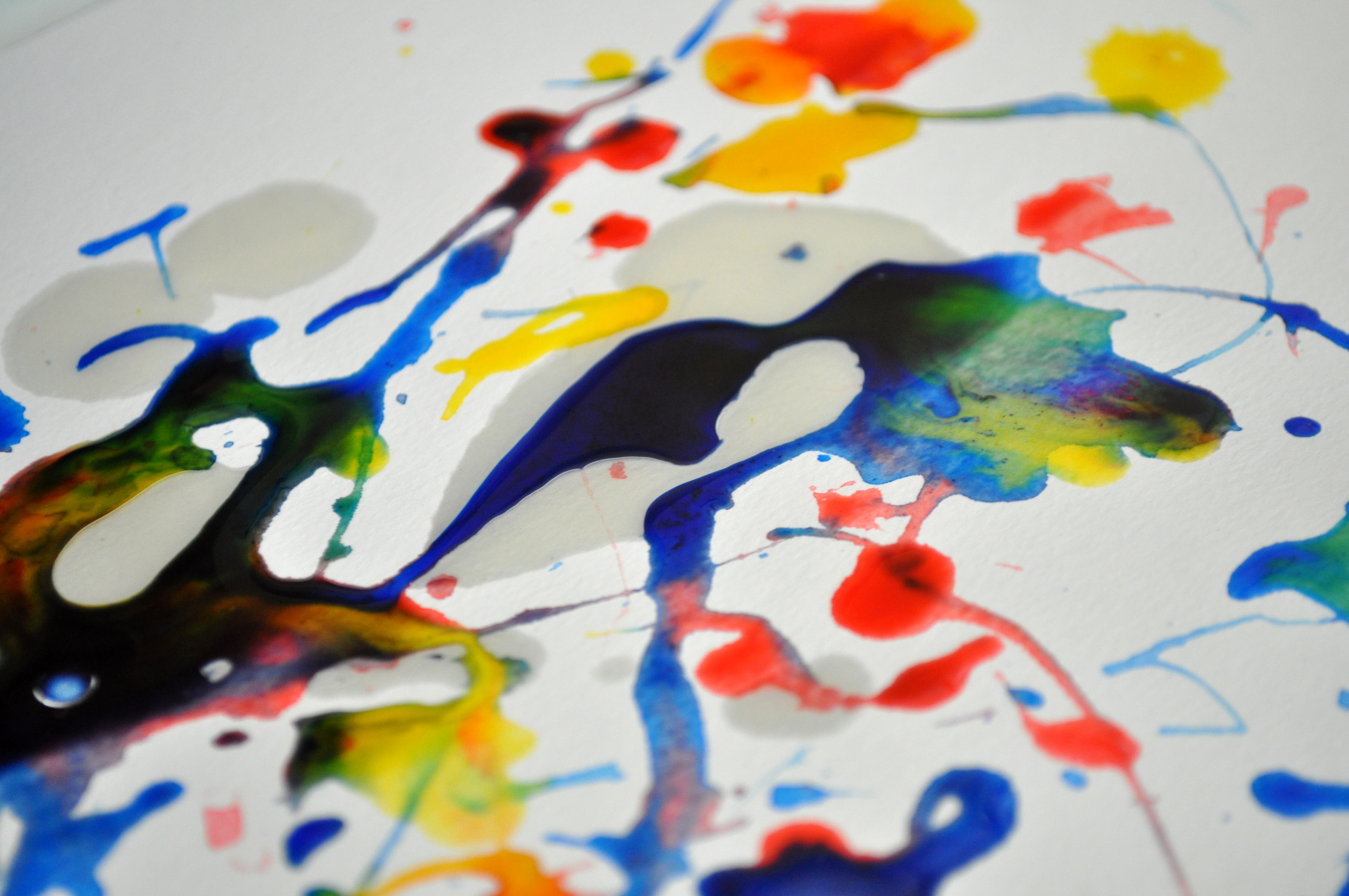
The papers might remind you of Eric Carle’s pictures. Most of them were made in one of my Eric Carle Tissue Paper Workshops. The workshop goes over the nitty gritty of adapting Eric Carle’s processes and techniques to create unique collage papers with students or just yourself. Learn more about my workshop here.
You could make similar papers yourself or with kids using with paint, tools like our Silly Brushes, and tracing paper. We put the papers in plastic document sleeves and then used a 3-hole-puncher to make holes for the 1″ binder rings that connect the sleeves together. We’ve used this display method before and have noticed teachers and parents taking pictures and talking about how they would use the idea in their class or at home.
Is this idea inspiring to you? Tell us about how you might or have used tension rods, document sleeves, and binder rings in your home or classroom.
Telling Our Stories
Now through March 13, 2012
Free with Museum Admission
Timelines are records highlighting significant events and journeys in the past. Create a personal timeline with drawings of your most memorable life events. Share your memories on The Memory Bank wall in the back of the Studio.
Many visitors have already contributed their memories to our wall (See how we put it all together in the post, here.)
If you’ve visited the studio, you may have noticed that we’ve have out only a select set of materials for you and/or your family to play around with. For instance, you may have come when we’ve offered collage paper and glue, but no scissors. Maybe you wondered if we a.) misplaced our scissors or b.) thought we wanted to play a bad joke . The answer is c.) none of the above. We intentionally limit the variety of materials offered in our projects for many other reasons. I’d like to discuss those reasons here and invite you to respond.
One reason we offer specific or limited materials is to inspire creative problem solving. When a guest asks for a material we’re not currently offering, our response is to ask, “what is it you’re trying to do?” After hearing about their idea, we might follow up by asking “how might you do that with what’s here?” and then help them come up with ways to explore, or alter their idea. The goal is to help our guests, kids and adults alike, see the possibilities inherent in materials, and use them in ways they hadn’t thought of before.
Its like the idea that you could have lots of friends that you know only a little, or a few friends you know really well. When we have fewer materials to work with, we have the opportunity to get to know each of them really well. An unlimited choice of materials has its place in certain settings, of course, but our goal is to help people really get to know how materials “speak” to and through them. Since the majority of our guests are young children and their families, we encounter many (kids and adults alike) who are new to looking at and making art, so in our setting, limiting materials makes sense. Our Public Art Projects last for multiple weeks, in part, so that regular guests could have multiple experiences with a set of materials. It’s possible that during each visit the materials could be used in very different ways.
Limited materials also encourage our guests to take risks. Recently, during a project in which we offered tissue paper for collage with oil pastels, a boy (maybe 10 years old?) asked for “regular” drawing materials. When I asked him what he meant by “regular” drawing materials, the other kids in his group chimed in (with a tone that suggested they admired his abilities and respected his interest) to say that “he is a drawer”. My response was to start a conversation with him. I learned that drawing was his preferred way to work (perhaps his artistic safe zone), and that he especially liked the Manga style. I asked him if he already had an idea for a picture he’d like to make today, and let him know that collage was about making things with shapes. So, I suggested, “I know you like drawing, but what if for today, you made your idea with shapes? Maybe you could just give it a try?” He did. He worked for a long time, and he was pleased with his work.
Sometimes we offer limited colors to help our guests make discoveries about color or color relationships. For instance, if we offer just blue and yellow paint, a new artist (young or old) might mix them on their paper and “discover” green. In the Studio, we try to watch for these moments and help them be noticed. For another example, if I’m going to select materials inspired by a picture book about a visit to the beach, I might offer all colors, but sort them by temperature: warm colors (red, yellow, orange to suggest the sun and sand) and cool colors (green, blue, violet to suggest the water). Offering limited colors is a way for our guests and students to learn about color without us saying “today you are going to learn about color temperature” when they walk in the door.
Cathy Topal and Lella Gandini also make an interesting note in reference to working with found objects in their book Beautiful Stuff (pg. 90):
“As soon as we limit children to one color, the possibilities open up. Children become much keener and more discriminating observers- and so do the teachers.”
So, this is where I hope you will weigh in. How do you approach materials choices with children or students of any age? Do you offer specific materials? Let them have access to all their materials all the time? Something else?
Last spring The Studio ran the Public Art Project Circle Circus, when visitors could use an array of geometric shapes to create a collage or three-dimensional assemblage. To mix things up a bit from a typical collage project, visitors could change the shapes any way they wished, but without the use of scissors. (Sneaky challenge, huh?) We prepared TONS of shapes ahead of time for the project: squares, rectangles, triangles and circles and arranged them on trays in labeled baskets.
Geometric shapes with straight sides are easy to prepare in advance with a paper cutter, but prepping lots of circles can be more challenging to cut by hand. After testing (and wearing out) several paper punches over the years, we’ve come to depend a couple of the best brands and styles whenever we need circles for the Public Art Programs and Workshops.
Our first favorite (shown above) is the adjustable Circle Cutter by Fiskars. The blade arm cuts circles between one and eight inches in diameter. The cutter locks in place as you twist the blade around, preventing shifting and cutting mistakes. Also, because it’s clear, it’s easy to position it anywhere to avoid wasting paper. The blade is sharp enough to cut through at least two sheets of construction paper at once. You will need a self-healing mat when using this cutter or you could slice right into your table.
Another one of our favorites for cutting circles is the Fiskars Squeeze Punch Round’ and Round’. We use the extra large 2-inch size, but this style punch is also available in other sizes. For this new design, Fiskars flipped the cut-out to the front so it’s easy to see exactly where you’re punched. Our volunteers love this style because it’s very easy to squeeze the handle without tiring out your hand. If you only have the budget to add one style to your arsenal, this in the punch you should own!
For very small circles we’ve recently been using Martha Stewart’s 1-inch punch. We prepare circles on strips of paper and hang on to them for future projects. Play with the spacing between each punch and the negative strips will be just as much fun to use in a collage as the shapes themselves.
Above are a couple of solutions to our “no scissors” challenge during Circle Circus. Do you have a favorite paper punch style or brand? Let us know, and maybe we’ll test it in The Studio!
Here’s the video from my appearance on WWLP’s Mass Appeal yesterday. I hope it inspires artmaking in your home or classroom! You can find the Valentine Card templates I reference in my segment here.
Many thanks to Seth Stutman for hosting the segment and to the rest of the staff at Mass Appeal for having The Carle on the show. It was lots of fun!
January’s Special Sunday was designed by Erin Christie as part of her final internship project in The Art Studio. She planned the activity, sorted and prepared the materials, and introduced visitors to the project throughout the day on Sunday, January 29th. Continue reading below for a full description of the day, documented by Erin.
One Sunday a month we have an additional art activity in The Studio for visitors to try. This month, the project I designed allowed visitors to explore the process of building with paper.
Visitors started with an array of colored construction paper, newsprint, coffee filters, and cardboard. They created by folding, bending, crumpling, and taping them together into sculptures.
The final part was a collaborative effort to construct a city with their creations. I covered a long table in black paper and drew a road. The rest of The City’s design was up to the visitors!
One little boy shared his sculpture, a row of connected houses, as he explained. They were from all over the world, an igloo made from an upside down coffee filter and a taller tree house with a rope ladder.
The project created quite an experience, producing a deeper understanding of manipulating paper and an eclectic neighborhood (including a miniature Eric Carle Museum!)
For more information about upcoming Special Sundays click here. For more information about the Art Studio internship click here.
If you live in viewing area of WWLP 22 News in Western MA, check out Mass Appeal tomorrow at 11am. I will be demonstrating how to make Valentines with your kids or students. If you’re not in our viewing area, you’ll be able to get a link to my segment here and on The Museum’s Facebook page later.
In The Art Studio Latin Landscapes April 10 - May 21, 2013 Free with Museum Admission Capture the beauty of the landscapes from Latino Folk Tales: Cuentos Populares–Art by Latino Artists and create a picturesque panorama adapting the textured drawing style of illustrator Raul Colón.