Here’s a sample of all the fun things guests are making in The Studio lately. The current Public Art Project is Animals in Motion, making moveable animal mobiles or puppets with chopsticks, coffee stirrers, paper card stock, wire and lots of fun furry and feathery materials. Above, Maiya and her mom made a few birds, and a rabbit that really hops! Below is a beautiful pair of galloping (Blue?) horses by two sisters.
Brown Bear, Brown Bear What Do You See?
A pair of friendly giraffes marching side by side…
One slithery, bejeweled snake…
And a few more feathery friends!
Animals in Motion runs now through April 9th, 2013, so stop by and make your favorite animal move.
**Don’t forget to enter The Carle’s Call for Caterpillars Contest for the chance to win an original doodle by Eric Carle! Visit www.carlemusuem.org/call_for_caterpillars for contest details. Submissions must be postmarked by May 31, 2013.**
In addition to giving a color-mixing watercolor demonstration, Melissa had the great idea to offer a mini kite workshop to celebrate spring!
Guests decorated colorful pieces of crepe paper, and after a few simple steps, many kites flew wildly on the patio and in the apple orchard. Fortunately, most of the snow from last week’s storm melted, the sun was shining and there was a nice steady breeze to guide the kites through the air.
We used the super easy kite tutorial from the blog Better in Bulk. Click here for the kite directions that worked like a charm. We added the streamer tail with construction flag tape and colorful plastic bags for some extra pizazz to the kite’s simple design.
After the kite workshop, guests gathered in the Reading Library to hear Melissa discuss her process, read her books, and even do some facial expression sketching exercises in mini sketchbooks. Melissa told us that for her newest book, A Splash of Red, in addition to working with watercolor and collage, she carved and painted pieces of wood to include in one of the illustrations of Horace’s paint brushes and pencils, how cool!
Below is large pop-up Melissa made from old posters attached to a folded piece of cardboard. She encouraged everyone to use materials around their own homes to make their own towns, jungles, or underwater habitats.
**Don’t forget to enter The Carle’s Call for Caterpillars Contest for the chance to win an original doodle by Eric Carle! Visit www.carlemusuem.org/call_for_caterpillars for contest details. Submissions must be postmarked by May 31, 2013.**
Therese Brady Donohue, Director of Picture Book Theater and founder of The Amherst Ballet is leading an exciting workshop called Paint, Shape, Create! for ages 9 through adult here in the Studio on April 20th from 1-4.
Inspired by works in our last exhibition Beyond Books: The Independent Art of Eric Carle, participants in this upcoming workshop will channel Eric Carle and their own inner artists as they paint on aluminum foil and then experiment with shaping it in strips and composing the strips on a painted canvas.
Therese, well known for costume and mask design and construction as founder of Amherst Ballet, told me “For eight years I have worked with reproducing Eric Carle’s picture book images, adapting them into puppets and costumes. I am always interested in taking a technique and creatively using it in different ways. When I saw what Eric had done as an independent artist taking his signature textures and applying them to foil and creating dimension, it spoke to me as a fun technique to introduce to artists of all ages. It is not complicated and does not require in-depth talent to experiment with this technique. This is also a good technique for educators to use in the classroom up through high school.”
With that in mind, Therese and I thought that this creative process would be a great opportunity for an intergenerational class experience in which young artists, parents, grandparents, artists, and educators could work side by side and learn from each other.
The Carle has offered parent/child and family programs before, but with this workshop the elementary-aged artists can participate with or without their parent present. By age 9 some young artists are clear in their creative passions and are ready for an opportunity like this.
Therese and I are both excited about the creative expression and layered learning that will happen this workshop. If you or someone you know in our area might be interested in this workshop learn about how to register (carlemuseum.org/register ) today! We’ll need to have at least 5 participants registered by April 12, and space is limited, so don’t wait!
~ ~ ~ ~ ~ ~ ~ ~ ~ ~ ~ ~ ~ ~ ~ ~ ~ ~ ~ ~ ~ ~ ~ ~
Don’t forget to enter The Carle’s Call for Caterpillars Contest for the chance to win an original doodle by Eric Carle! Visit www.carlemusuem.org/call_for_caterpillars for contest details.
It feels good to be back at The Carle! I’ve been scarce for a while because a very young person has come to live with my family and I took some time off to get to know her. In the past two months I’ve learned that life as a working mom of 2 kids under 2 years old is super busy but full of learning. I’m grateful that I get to spend time at home and time at The Carle learning about how toddlers explore materials and use them to make discoveries about the world.
While I’ve been out for most of our last Friday morning Materials Play for Toddlers series in the Studio, I wanted to share some pictures that were captured in a few of the sessions:
Pictured above: marbles, tempera paint, liquid watercolor paint, & black construction paper placed in the bottom of a plastic paper tray. Below, paper circles, cookie tins, tempera and liquid water color paint. Shake rattle and roll!
***Safety Note: if marbles are a choking hazard in your setting try golf balls or ping pong balls.***
Below: plexi mirrors, washable markers, water-soluble oil pastels, wide cups of water and brushes.
Truck Printing! Tempera squeezed into trays, toy cars and rolling stampers, black paper taped to the floor in the shape of a road. Secondary colors (violet, green and orange) chosen so that the mixture of the 3 would resemble mud.)
A buffet of beautiful ingredients: (colorful paper dot confetti, raffia snipped to smithereens, reflective plastic Easter grass, plastic newspaper bag shreds, white feathers, yarn scraps, clementines box mesh, (in other words, all the bits we had laying around) . . .
. . . pressed and sprinkled onto contact paper (paper frame attached first). This is my own sun catcher experiment. My guest’s compositions were less ordered, more spontaneous.
I hope this inspired some experimentation and creative fun with your toddlers! Happy mess-making!
Don’t forget to enter The Carle’s Call for Caterpillars Contest for the chance to win an original doodle by Eric Carle! Visit www.carlemusuem.org/call_for_caterpillars for contest details.
As The Carle’s Public Art Program Educator, I have the unique challenge designing the drop-in art activities for The Studio’s ongoing Public Art Program that change every 4-6 weeks. If you follow our blog regularly you’re familiar with the variety of projects we offer: bookmaking, painting, sculpture, collage, drawing and printing to name a few! Whether our guests are novice art makers or seasoned veterans, anyone can try their hand at our current activity and use the materials at their level of expertise. One of the often overlooked details of designing each art project is figuring out the best way to organize the art materials guests will use at the tables in various sized baskets.
For one of our recent Public Art Projects, Mapping Makeover, I made some fun new labels to organize the drawing tools into warm, cool and neutral colors. To help our young guests learn the different color families, the paper liners are in bright colored paper by Canson. On each label I added small dots matching the drawing tools’ hues and familiar images from Eric Carle’s The Very Hungry Caterpillar in warm, cool or neutral colors.We use Avery templates in Microsoft Word to make all of our labels, very quick and easy! We use brass fasteners to attach the cardstock labels to the 3 different sizes of baskets in our collection.
The photos below are the basic steps for adding a label to a basket without tape. 1. Stick the label to a precut piece of cardstock that fits snugly on one side of the basket. 2. Use a bookmakers awl or another sharp tool to make a hole where you want your brass fastener to go. 3. Secure the fasteners to the back of the basket and add the materials. When the labels are not in use I store like-labels rubber-banded together in drawers by category, then they’re easy to find the next time we need them.
Sometimes we organize the paper in specific ways, like by the shape of the papers.
Other times the labels are more general, like “drawing tools” and “collage papers” so we can reuse the same labels for different projects.
We also design signage for specific projects to help guests take their projects further like, “How to make an accordion book”.
How do you organize the art supplies in your classroom or at home for children?
Don’t forget to enter The Carle’s Call for Caterpillars Contest for the chance to win an original doodle by Eric Carle! Visit www.carlemusuem.org/call_for_caterpillars for contest details.
Diana, Meghan and I all had the privilege of teaching a series of art classes through our contract with Amherst Public Elementary schools. I spent four weeks going to Fort River to teach some of the museum’s curriculum to a group of very creative students. This type of teaching is a great way to introduce our programs to students who have not been to The Museum, but I also loved meeting students who could share their memories of going to The Carle. I had several children that could tell me about seeing artworks in the galleries and visiting The Studio to make their own piece of art to take home. The projects were different each week, from using stamps to make textured paper, to making a collage house with found objects and experimenting with bookmaking techniques. You can see Diana’s earlier post about her bookmaking lesson here. For the last session we got to explore how to make monotype prints. Printmaking is one of my personal favorite art forms and it is always a pleasure to see a child pull their first print off the press.
The students were quick learners to figure out the many the steps to making a print and they were eager to get started after I demonstrated the process. Each student began by using a brayer to apply a thin film of ink to a plastic printing plate.
Then came the fun of drawing a design onto the plate with a Q-tip. Some of the students planned out very careful designs while others had fun drawing in a more free-form way with many curvy lines and dots. The wonderful thing about doing monotype prints is that each print is different and unique.
For the last step the students got to turn the handle on the press to roll their plate and paper together. After the plate went though our portable printing press the image was revealed! We were lucky to have our Spring Studio intern, Luna, to show the students how to do this last exciting step. As soon as a one print was finished the children were eager to start the process over again so each student was able to make many prints over our one hour class.
When students first learn about printing it is always fascinating to see their surprise when they notice that the image or words they drew are suddenly reversed. After making this discovery the students had fun figuring out how to write messages backwards on the plate so that the finished print would be the proper direction. The translucent ink we used allowed us to explore color by layering one print on top of another to see how the colors would blend.
All three of us have had a great time going to the local schools to share art-making with students outside of the museum. These programs have given us a way to get students engaged in new ways of making art and exploring their creativity. We hope to see some of the friends we made come to visit the museum in the future! A special thanks goes to my friend and fellow teacher, Mr. Lott, for letting me use his beautiful classroom space for my lessons.
Did you know we categorize all of our posts by type of media? You can search for printmaking or lots of other key words by clicking on “Categories” list on the left side bar of our blog. For more posts about printmaking in The Studio click here.
Don’t forget to enter The Carle’s Call for Caterpillars Contest for the chance to win an original doodle by Eric Carle! Visit www.carlemusuem.org/call_for_caterpillars for contest details.
Tomorrow is the first day of the new Public Art Project, Animals in Motion, where we invite you to create a moveable animal mobile of your favorite creature. It’s inspired by the exhibition The Art of Eric Carle: Feathers, Fins and Fur, opening Tuesday, March 12th in our West Gallery.
The video above is an inspiring glimpse into the world of large-scale kinetic sculpture. In 2008 The Atlanta Botanical Gardens featured an outdoor exhibition of 16 kinetic sculpture artists displaying their large moveable sculptures around the gardens. This video, created by PBA30 Atlanta’s PBS station, features the kinetic artists: Tim Prentice, Zachary Coffin, Kristina Lucas, George Sherwood, David Fried, and Susan Pascal Beran. Which sculpture is your favorite?
Inspired to create a mobile at home?
Click here for a very sweet and thorough video tutorial by Big Red Hat Kids on how to make an Alexander Calder inspired sculpture from wooden dowels and air-dry clay.
Click Here for a tutorial by Blick Art Materials on how to make a kinetic Dura-Lar mobile.
For more videos like the one above, search “kinetic sculpture” on YouTube.
I hope to share some photos of visitors’ animal mobiles in my next post, so stay tuned!
Don’t forget to enter The Carle’s Call for Caterpillars Contest for the chance to win an original doodle by Eric Carle! Visit www.carlemusuem.org/call_for_caterpillars for contest details.
It’s February vacation week and we’ve been busy making maps of all sorts in The Studio. Meet our fleet of future cartographers!
Adding some land and sea…
The brown shape is Florida. He said he colored it in a warm color because it’s hot there.
These are pictures of the creatures that live on the land and in the ocean on her map.
“Treasure Land”
A railroad in the “old fashion map style from 1998″
This treasure map is read from right to left. The treasure is protected by a dinosaur, a giant octopus/squid and a crane (the treasure is sitting under the paper crane on the bottom left).
“Rainbow Island”
This is another treasure map with a squid, a skeleton and a family of dinosaurs protecting the treasure.
“Our happy vacation to the creek”
This is the Bermuda Triangle protected by a giant dragon in the middle of the ocean.
Thanks to all the Museum guests who shared their artwork with me! The current Public Art Project, Mapping Makeover is running now through March 5th.
Don’t forget to enter The Carle’s Call for Caterpillars Contest for the chance to win an original doodle by Eric Carle! Visit www.carlemuseum.org/call_for_caterillars for contest details.
Hi! I’m Sarah Johnston and I work part-time in the Studio and conduct Student Outreach Programs for The Carle. Diana and Meghan invited me to contribute to the Studio’s blog about once a month, so I’m excited to start sharing some of my ideas with you. I have a background in art education and taught elementary art for five years in Chicago before relocating to Western Massachusetts with my husband in 2011. I hope you enjoy my first post!
There is something very magical about making the first footprints, snow angels or other marks in a fresh blanket of snow. It often makes me think of a blank canvas just waiting for an artwork to emerge. This project captures that magic in a slightly different and more colorful way. The materials you need to snow paint are ones that you most likely have in your home already, even if you are snowbound. So if your family is looking for something different to do in the snow, give snow painting a try.
The Materials:
Condiment style bottles (we purchased ours from Target)
Food coloring and/or old and dried out markers
Snow!
Part of the fun is mixing up different colors of “paint” into your bottles. I found that about 4-5 drops of food coloring in around 6 oz. of water will give you bright enough colors. The process of making the paint could even be used as a quick lesson in color mixing and discovery. As a former art teacher I often looked for ways in which children could discover on their own how colors mixed to form new colors. The food coloring box may only give you some of the colors in the rainbow so you might have to mix the other colors. What happens when you add a drop or two of red into yellow? What colors do you think you need to mix to make purple?
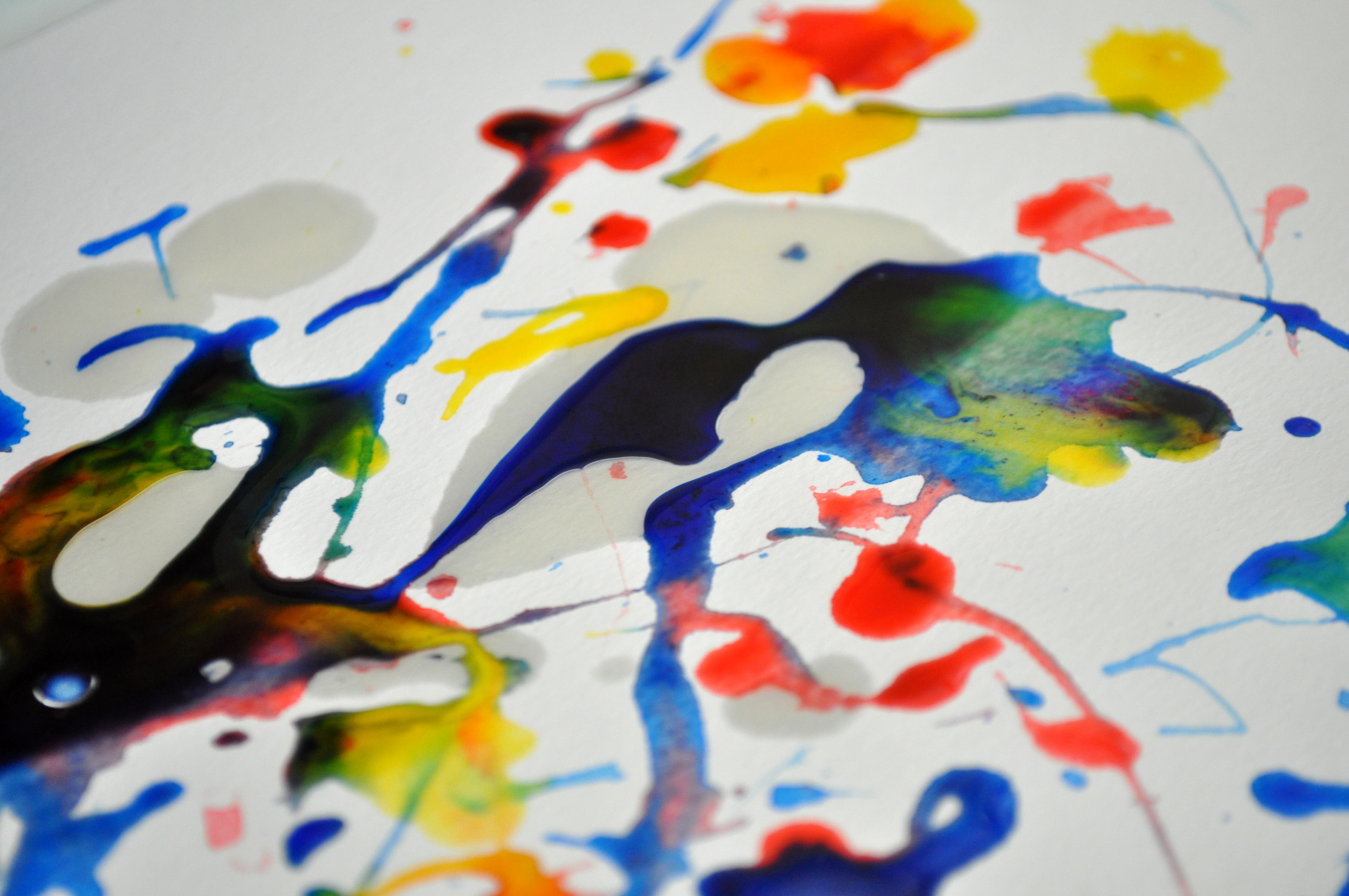
If you don’t have food coloring in your kitchen I found another way to make quick and easy “paint” when we were purging the Studio’s marker collection. Older and dried out markers may not have enough color to draw with anymore, but if you drop one or two markers into your bottles with water then you will have some other vibrant colors to paint with. Once your colors are mixed up it’s time to go outside and try painting on the snow. The bottles should give enough control to write, draw or just spatter like Jackson Pollock.
Have you used old markers successfully in art projects? I’m always looking for ways to reuse regularly discarded materials, so I’m going to continue exploring the possibilities of reusing old markers. Hopefully I’ll share with you my findings!
Don’t forget to enter The Carle’s Call for Caterpillars Contest for the chance to win an original doodle by Eric Carle! Visit www.carlemusuem.org/call_for_caterpillars for contest details.
To celebrate The Eric Carle Museum of Picture Book Art’s 10th anniversary year, we invite friends, families, schools, and other organizations throughout the country and abroad to create 3-dimensional caterpillar sculptures out of found materials. Be inspired by Eric Carle’s most beloved character, The Very Hungry Caterpillar, and transform ANY combination of recycled or found materials (plastic, paper, foam, wood, metal, etc.) into a 3-dimensional caterpillar sculpture. Photographs of the caterpillar sculptures will be displayed at The Carle and on The Carle’s Facebook, Twitter, Pinterest and homepage.
What You Could Win:
Three entries will be chosen at random at the Museum’s Children’s Book Festival on June 8, 2013 and will receive an original doodle by Eric Carle!
How to Enter:
Have fun creating your caterpillar either as an individual or part of a group.
Submit up to four digital images of your sculpture. These photos can be of the various stages of fabrication or of the completed caterpillar taken from different angles. Photos should be high-quality .jpg images, no larger than 2MB.Please do not send original artwork!
With each submission, please provide artist(s) name(s), a daytime phone number, email address and mailing address of the primary contact. Primary contact must be 18 or older.
If you are sending multiple entries please put photos of each submission in a separate folder on the CD.
How to send us your digital images:
Mail images on a CD to: Call For Caterpillars, The Carle, 125 West Bay Road Amherst, MA 01002
Email images as attachments to: callforcaterpillars@carlemuseum.org (see above for photo size guidelines)
Submissions must be postmarked by May 31, 2013. Pictures of the sculptures will be
displayed at the Museum either on a digital picture frame or printed and displayed in the Art
Studio from June through August 2013.
Submitted photos may be featured on The Carle’s social media pages, website or print
publications. Photos become the property of The Eric Carle Museum of Picture Book Art
and will not be returned.
To print out a PDF of the contest flyer, including guidelines and rules, click here!
For more information visit www.carlemuseum.org/Call_for_Caterpillarsor email callforcaterpillars@carlemuseum.org
Stay tuned for future posts about this contest. We hope to see your caterpillars very soon!
In The Art Studio Latin Landscapes April 10 - May 21, 2013 Free with Museum Admission Capture the beauty of the landscapes from Latino Folk Tales: Cuentos Populares–Art by Latino Artists and create a picturesque panorama adapting the textured drawing style of illustrator Raul Colón.