|
|
Posts Tagged ‘studio internship’
Monday, May 20th, 2013

This month I’ve been saying a lot of ‘goodbyes’ to student staff members as they leave for summer break. It makes me realize how fortunate we’ve been to work with such a stellar group of student employees over the years and see them move on to careers in art, museums and education. We invited our very talented former Studio intern, Anna McNeary, to share this marbling paper activity she taught recently to children at ArtSpace Charter School in Swannanoa, NC.
 Anna McNeary working on her final Studio project, fall 2010
I spent a very fruitful semester interning in the Art Studio during autumn of 2010, while I was attending Smith College. Since moving on from both the Carle and Smith, I’ve continued to pursue opportunities in art education. After I graduated last May, I moved to Asheville, NC and began working in the after-school program at ArtSpace Charter School. ArtSpace is an arts-integrated K-8 public charter school in Swannanoa, NC.
ArtSpace is a great learning and teaching environment for any person who accepts art as a universal teaching tool, since the philosophy of the school is based on a belief in creative learning across academic disciplines. The projects that I tried with ArtSpace students were directly informed by my experiences at the Carle. Visual Thinking Strategies and the Reggio Emilia approach to teaching were often on my mind, and I gravitated toward open-ended, process-oriented projects intended to let the kids explore materials and experiment with technique. This approach to making art with children is, not surprisingly, very compatible with ArtSpace’s culture of learning.

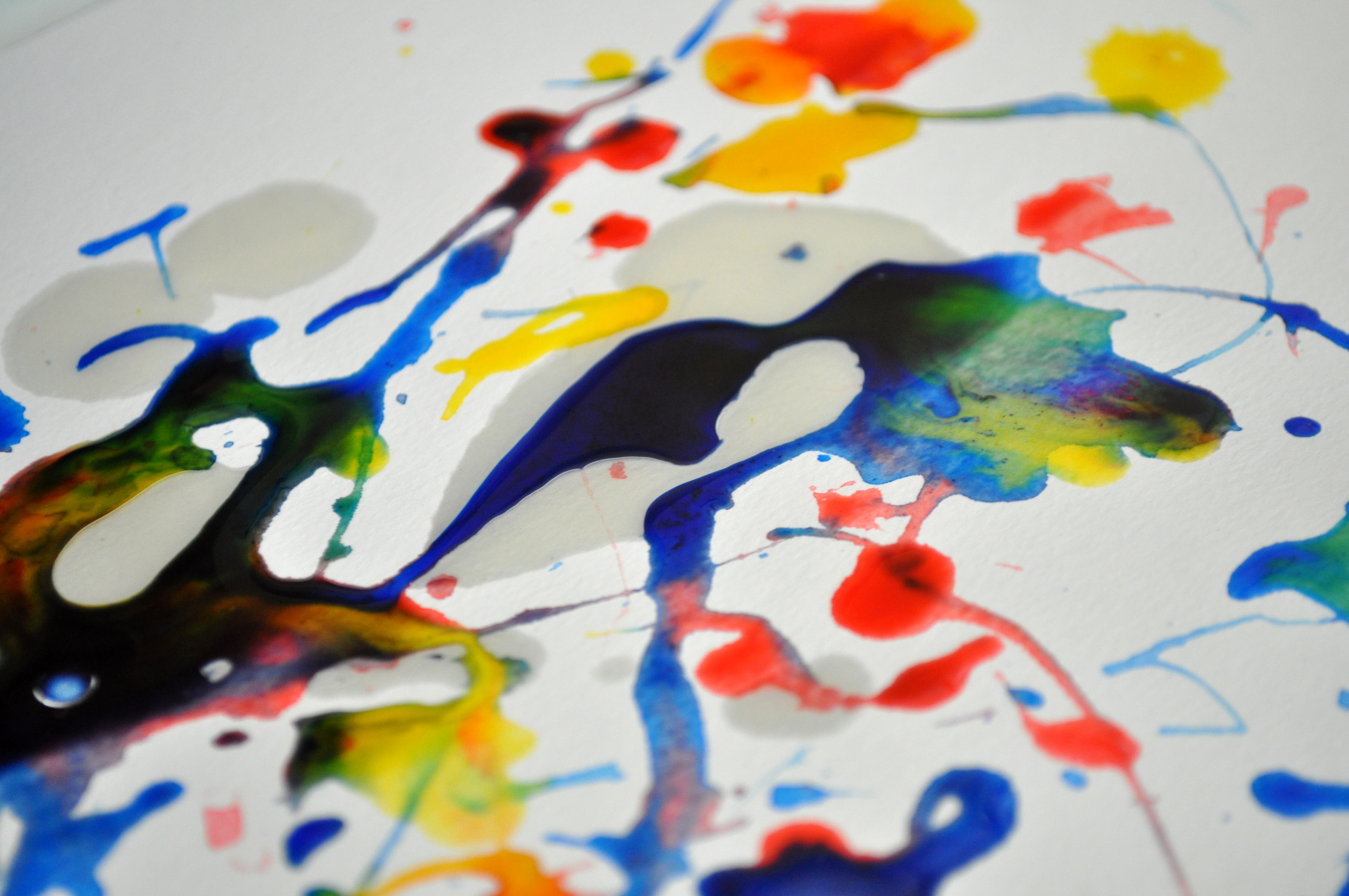
I’m a printmaker, so some of my favorite projects drew on printmaking concepts. The transfer of images is perhaps the most central concept in printmaking, and it’s really what made our paper marbling activity so surprising and exciting. For those unfamiliar with the medium, marbling is the process of creating designs by floating pigment on the surface of a liquid substance, like water or oil. When you gently press a substrate like paper or cloth to your colored surface, you’ll get a swirly, psychedelic transferred design. Here’s an accessible and kid-friendly interpretation of marbling that I found and adapted for AfterCare.
Materials:
containers with seal-able lids
shallow pans
vegetable oil
food coloring
forks, spoons, skewers
sturdy paper, such as card stock

In a few containers with tightly seal-able lids (mason jars work well), I combined about 1/4 cup vegetable oil with a generous amount of food coloring. I shook up my “dye” vigorously enough to get it looking pretty homogenous. When I arranged our workspace, I put down plenty of newspaper over two long tables, and then put our supplies in the center. I set out two rectangular cake pans filled about halfway with water, our jars of colored oil, spoons, forks, wooden skewers, and a stack of light-colored card stock. I knew this activity had the potential to be messy, so I put the marbling station in the center of the workspace so that kids could surround the materials from all sides, and then quickly transfer drippy paper to the newspaper at either side.

I had a few eager marblers right off the bat, and once we got going, more inquisitive kids joined us. I had them start by spooning drops of oil onto the water. For the sake of keeping our designs from getting too muddy, we had a pan for warm colors (orange and red) and cool colors (blue and green). After they had added enough for the surface to be fairly crowded with colorful blobs, we used the forks and skewers to stir the oil into swirly patterns. Then, one by one we each touched the card stock to the liquid for about three seconds. It was such fun to see the kids’ thrilled reactions to their beautiful marbled prints–their enthusiasm was palpable, and soon we had a quick-paced marbling factory running at the back of the classroom!
The kids were responding to one of the most captivating things about printmaking, which may be my favorite part of the process: the small moment of suspense before you see the print you just pulled. Will it be beautiful, weird, unexpected, perfect, or all of those things? It’s a joy to watch kids have that experience, and it’s a great reminder of why art education is so important.

For more information about The Art Studio Internship Program, CLICK HERE.
There’s still time to submit your caterpillars to our CALL FOR CATERPILLARS contest! CLICK HERE for more information and how you and your child can enter.
Tags: Anna McNeary, marbled paper, studio internship Posted in Activities, Elementary School, Painting | No Comments »
Thursday, March 7th, 2013

Diana, Meghan and I all had the privilege of teaching a series of art classes through our contract with Amherst Public Elementary schools. I spent four weeks going to Fort River to teach some of the museum’s curriculum to a group of very creative students. This type of teaching is a great way to introduce our programs to students who have not been to The Museum, but I also loved meeting students who could share their memories of going to The Carle. I had several children that could tell me about seeing artworks in the galleries and visiting The Studio to make their own piece of art to take home. The projects were different each week, from using stamps to make textured paper, to making a collage house with found objects and experimenting with bookmaking techniques. You can see Diana’s earlier post about her bookmaking lesson here. For the last session we got to explore how to make monotype prints. Printmaking is one of my personal favorite art forms and it is always a pleasure to see a child pull their first print off the press.

The students were quick learners to figure out the many the steps to making a print and they were eager to get started after I demonstrated the process. Each student began by using a brayer to apply a thin film of ink to a plastic printing plate.

Then came the fun of drawing a design onto the plate with a Q-tip. Some of the students planned out very careful designs while others had fun drawing in a more free-form way with many curvy lines and dots. The wonderful thing about doing monotype prints is that each print is different and unique.

For the last step the students got to turn the handle on the press to roll their plate and paper together. After the plate went though our portable printing press the image was revealed! We were lucky to have our Spring Studio intern, Luna, to show the students how to do this last exciting step. As soon as a one print was finished the children were eager to start the process over again so each student was able to make many prints over our one hour class.


When students first learn about printing it is always fascinating to see their surprise when they notice that the image or words they drew are suddenly reversed. After making this discovery the students had fun figuring out how to write messages backwards on the plate so that the finished print would be the proper direction. The translucent ink we used allowed us to explore color by layering one print on top of another to see how the colors would blend.

All three of us have had a great time going to the local schools to share art-making with students outside of the museum. These programs have given us a way to get students engaged in new ways of making art and exploring their creativity. We hope to see some of the friends we made come to visit the museum in the future! A special thanks goes to my friend and fellow teacher, Mr. Lott, for letting me use his beautiful classroom space for my lessons.
Did you know we categorize all of our posts by type of media? You can search for printmaking or lots of other key words by clicking on “Categories” list on the left side bar of our blog. For more posts about printmaking in The Studio click here.
Don’t forget to enter The Carle’s Call for Caterpillars Contest for the chance to win an original doodle by Eric Carle! Visit www.carlemusuem.org/call_for_caterpillars for contest details.
Tags: Fort River Elementary, Luna Goldberg, printmaking, printmaking with children, studio internship Posted in Elementary School, On the Road, Printmaking | No Comments »
Tuesday, February 5th, 2013
Reid, our January-Term intern, designed and hosted a really fun special Studio activity last week for Museum guests. Here is her report on the planning process of the project and her reflection on the day.

When brainstorming for my Special Sunday activity, I knew right off that I wanted to experiment with the way we use light to make images. In the studio, our large windows provide so much beautiful natural light, and I wanted to utilize this feature in the activity. Meghan and I were bouncing activity ideas off each other when we came up with the idea of tracing shadows. Upon further elaboration we came up with the idea of using found objects to make shadow collages, tracing the lines, and finally painting over the drawn images. Initially I was having trouble deciding between collaging and painting, and this project combined the two!


Once I knew what I wanted to do, I began to plan out what materials we would use. I played with different kinds of drawing tools, paints, and paper to find the perfect combination of supplies. In the end, I decided to use Staonal crayons with tempera cake paints on large pieces of watercolor paper. I found the paint appeared bold and bright on the paper and didn’t smudge the Staonal, so the tracings remained intact.

We put out baskets of found and natural objects that would cast interesting shadows. Each visitor could choose up to 4 objects at a time, and when they were done with those they could trade them back in for different pieces to trace. We had natural objects like stones, pinecones, and seashells, along with found objects like ribbon, bottle caps, and mesh. It was important to have a variety of different shapes and sizes available.


On the day of the project we were lucky enough to have gorgeous sunny weather. Of course, because of New England’s unpredictable weather, we were prepared to use an overhead projector as a back-up plan in case the sun wasn’t out. We arranged the back of the art studio so that the tables were pushed to the right side; this area was set up as the painting area, complete with paintbrushes, water, sponges, and of course paint!


The left side of the studio was the tracing area. This is where visitors would put down their paper on the floor or sit on a chair and trace on a stool to arrange their objects and trace the shadows. We had cool shades that had previously been crafted by staff members on the windows already, and we moved these so there could be some interesting shadow patterns on the floors for the visitors.

The cool thing about this project was it could be as complicated or as simple as you want it to be, depending on age level, ability, and interest. I didn’t want something where the guidelines were super stringent. If a child didn’t want to draw on the floor, they could just paint at the table. I made sure to emphasize that when talking to the visitors. There were no rules to this project; the point of it was to allow the materials and the environment to inspire and to create.


I would say this project was definitely a success. It was exciting to see the families collaborating with each other and having fun with each other’s work. This activity was able to engage visitors of all ages. I was delighted to see how creative the children (and adults!) were with this project. Some visitors were very abstract with the images they made, while others used the shadows to create scenes out of their objects. All in all, it was a very fun afternoon in the art studio!
Tags: Alexandra Reid, light, shadow play, studio internship Posted in Activities, At The Carle, Drawing, Elementary School, Found Materials, In the Studio, Middle School, Mixed Media, Nature, Painting, Public Art Program | 2 Comments »
Thursday, January 31st, 2013

Making pop-up books is always one of my favorite projects to teach. I had the chance to make some books with a group of students at Wildwood Elementary here in Amherst a few weeks ago. I showed them how to make accordion books with pop-up tabs and trap doors. It was quite a creative group, so no two books were alike!

We did all of the folding and cutting steps together on the floor before moving to the tables to work with collage and drawing tools. It can be tricky for children to follow along with bookmaking steps and it makes such a difference having the group close together on the floor, versus sitting at their own desks. Students can help each other and work together and it makes it easier for me to scan the group for a student who is behind or confused with folding, cutting or gluing. At the tables, they worked independently for the last half-hour adding details to their books with colorful collage papers, sticker shapes and metallic colored pencils I brought along.


Some students where more interested in the collaging aspect of the project, while others were more interested in adding a story or text.


They were all very eager to share with me their finished books. Check out these trap doors and pop-ups by six-year-olds!


The Carle has a contract with Amherst Public Schools this winter to visit each of their three elementary schools in the city, Wildwood, Fort River and Crocker Farm. At each school one of our team of art educators will teach four one-hour art workshops for up to twelve students in each session as part of the after-school program. We love being able to visit local schools and libraries to meet children and families who may not know about The Carle and our programs.

I wasn’t able to document my other three sessions at Wildwood as extensively as the bookmaking session, but above and below are photos from the monotype printmaking lesson I did at Wildwood the week following the bookmaking class. Below is a photo of Reid, our January Term Intern helping a student run their plate through our portable printing press.

To learn more about The Carle’s Outreach Programs click here.
Thanks for having me Wildwood Elementary!
Tags: Alexandra Reid, Amherst, studio internship, Wildwood Elementary Posted in Bookmaking, Elementary School, On the Road, Printmaking | 1 Comment »
Wednesday, December 26th, 2012

The past few weeks we’ve been saying our goodbyes to all of our fabulous student staff members as they finish their semesters and head home on winter break. Recently our fall semester intern, Gabby Rosenberg, completed her final project, The Face Game, an interactive display for Museum guests in the Art Studio. Below she shares documentation on her progress creating the game this semester. Great job Gabby!

The Face Game was a chance for me to design an engaging activity for all ages. The goal for The Face Game was for guests, primarily children, to create funny faces on their own or collaboratively.
The Public Art Project running while I was designing my final project was Face It, making portraits with colorful cut papers. I wanted to create a humorous and open-ended activity to match the personality of the Studio space and the art project. The features I created are all intentionally outrageous in shape, color and proportion to lessen any pressure for realism or perfection.
In addition to being silly and having fun, The Face Game helps young children learn the names and shapes of different facial features, their correct placement, and identifying different facial expressions: happy, sad, angry or surprised.

The first step in the creation of the face was making a big oval from brown paper, about two feet wide by three feet long. Diana and I discussed how to make the face more sturdy and our solution was to attach the paper to cardboard with spray adhesive.
I struggled with which facial features to include and which to leave out. I ended up using eyebrows, noses, eyes, and mouths. I created multiple variations of each feature with different colored and patterned papers. To make each feature easy to recognize, I attached the parts to the same larger background shape that can be matched to an area on the face. For example, all of the eyes are glued on to larger circles, eyebrows on rectangles, and noses on triangles.
Some of the Studio staff helped me finish mounting the features to their brown paper backings and get them laminated. For the back of each piece I made a label with what part of the face it was (i.e. “eye”, “nose,” etc.) and a small strip of sticky-back Velcro so it could be easily rearranged on the large face shape.
Before having guests play with the game, we did a little test attaching and detaching the face parts. We realized that the brown paper face might tear if a child pulled hard on the Velcro. Diana suggested brushing acrylic matte medium around the pieces of Velcro on the face to help strengthen the paper and prevent it from tearing.

Once all the parts were complete, Diana and I made an area on the front bulletin board in the Art Studio to hang The Face. We hung it at a height so even littler children would be able to reach and interact with the game. Here is a photo of me talking with two little girls playing with the game shortly after we hung it on the wall. Instead of making traditional faces, they had a lot of fun mixing up the parts and putting them in an unusual order: noses instead of eyes, mouths instead of eyebrows and eyes instead of noses!

Final reflection
The idea of The Face project started because I wanted to make something that could stay at The Carle beyond my internship session. After discussing possible ideas with Diana, we came up with The Face Game. Personally, I was interested in designing an activity that was all about the face because faces and people are primarily what I focus on as an art studio major at Hampshire College. I think people of all ages can learn a lot from practicing how to document and represent other people, or just creating a made up character to strengthen their imagination. This project is a chance for people who don’t normally feel like artists to act like one, by designing a face and having fun while doing it! BIG thank you to everyone who helped out!
Tags: Face It, Gabby Rosenberg, studio internship, The Face Game Posted in In the Studio, Preschool, Public Art Program | No Comments »
Tuesday, February 7th, 2012
 Erin helping a visitor.
January’s Special Sunday was designed by Erin Christie as part of her final internship project in The Art Studio. She planned the activity, sorted and prepared the materials, and introduced visitors to the project throughout the day on Sunday, January 29th. Continue reading below for a full description of the day, documented by Erin.

One Sunday a month we have an additional art activity in The Studio for visitors to try. This month, the project I designed allowed visitors to explore the process of building with paper.

Visitors started with an array of colored construction paper, newsprint, coffee filters, and cardboard. They created by folding, bending, crumpling, and taping them together into sculptures.

The final part was a collaborative effort to construct a city with their creations. I covered a long table in black paper and drew a road. The rest of The City’s design was up to the visitors!

One little boy shared his sculpture, a row of connected houses, as he explained. They were from all over the world, an igloo made from an upside down coffee filter and a taller tree house with a rope ladder.

The project created quite an experience, producing a deeper understanding of manipulating paper and an eclectic neighborhood (including a miniature Eric Carle Museum!)

For more information about upcoming Special Sundays click here. For more information about the Art Studio internship click here.
Tags: 3d, collage, glue, paper, scissors, Sculpture Stories, Special Sunday, studio internship Posted in Activities, At The Carle, In the Studio, Materials, Mixed Media, Public Art Program | No Comments »
|