Neville by Norton Juster, illustrated by G. Brian Karas (Schwartz & Wade)
Juster and Karas bring about an ingenious foray into a “breaking into the neighborhood” story as a young boy looks to makes friends after moving to a new town. When his mother tells him to take a walk down the block, the young boy, here, suddenly throws back his head and hollers NEVILLE. Soon other children join in until everyone is wondering: who is Neville? Amusing and appealing, this story will be welcomed by parents whose children will be — or have just experienced — the trauma of moving into a new home.
On shelves October 25th.
* * * * * * * * *
Want more recommendations from The Carle Bookshop? Click here to read for Top of the Shelf book reviews.
It’s Banned Books Week, a week observed at the end of every September since 1982 to celebrate free access to information, while drawing attention to the harms of censorship. All across the country libraries and bookstores have scheduled events to highlight banned and challenged books and to celebrate our democratic right and freedom to read.
Today’s Picture Book Puzzler is made up of banned books from the American Library Association’s book list of the most frequently challenged and banned books from the last ten years. Some of the books that have been banned, even so recently as last year, may surprise you. Take a look at the cover images (they have been altered to protect their identities!) and see if you can name each title. Good luck and I’ll see you back here on Friday with the answers!
The 6th Annual Carle Honors is almost here! Tomorrow, September 22nd The Carle will be in New York City to kick off another year celebrating picture book art!
Copyright 1969 & 1987 Eric Carle
Each year The Carle pays tribute to four exceptional individuals who are dedicated to the art of the picture book and its integral role in art appreciation and early literacy. The year’s award recipients are Lois Ehlert (Artist), Jeanne Steig (Angel), Michael di Capua (Mentor) and Karen Nelson Hoyle (Bridge). To learn more about the recipients and about the awards, you can read my blog post from earlier this year here.
In addition to the awards ceremony, The Carle Honors will be holding its 4th annual fundraising art auction featuring original works by some of the industry’s most celebrated artists. This year’s contributing artists include Jon Agee, Harry Bliss, Etienne Delessert, Lois Ehlert, Jules Feiffer, Steven Kellogg, Barbara McClintock, Chris Raschka, Tomi Ungerer, Chris Van Allsburg and Rosemary Wells. Jerry Pinkney also created an original lithograph that will be sold on-site tomorrow evening to benefit The Carle. All works of art will be on display at Books of Wonder in New York until the end of the day today. You can also view them online here.
How amazing is this Steven Kellogg piece?
Copyright 1976 Steven Kellogg
Or this piece from Lois Ehlert’s new book, Ten Little Caterpillars?
Copyright 2011 Lois Ehlert
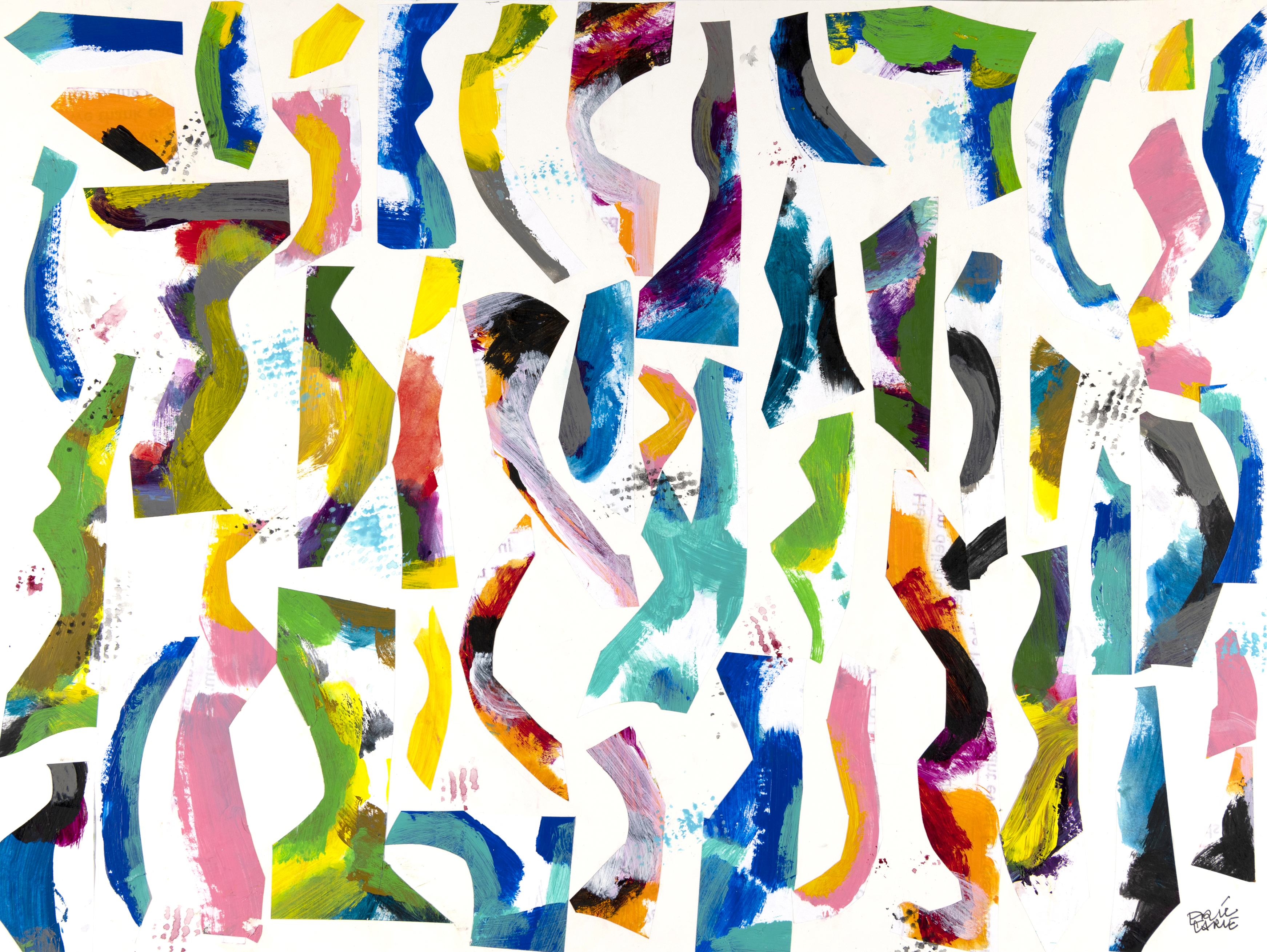
This year, in addition to original pieces of art, the auction will also include the chance to bid on once-in-a-lifetime experiences with authors and artists. These experiences include a personal tour of Tomie dePaola’s New Hampshire studio, followed by a dinner together at one of his favorite local inns, a personal tour of Kadir Nelson’s studio in Los Angeles, an original Rosemary Wells fresco in your home, a personalized poem written by none other than prolific Jane Yolen herself about the person of your choice, or an original name collage created just for you (or for someone you love) by Eric Carle. Wow!
Copyright Eric Carle
For details on each piece and starting bids, click here. Absentee bids are welcome and the silent auction will culminate tomorrow evening at The Carle Honors.
Here’s to another wonderful year of celebrating picture books!
DePaola incorporates eight December Italian festivals in his newest extravaganza starring the lovable grandmother witch and her bumbling companion Big Anthony. Special treats are being made for each of the occasions and, of course, Big Anthony meddles in the preparation. In the end, Strega Nona surprises everyone with a very special gift and Big Anthony? Well, he gets his “just desserts.” Once more, dePaola gets it right in a book to delight old and new fans.
On shelves October 18th.
* * * * * * * * *
Want more recommendations from The Carle Bookshop? Click here to read for Top of the Shelf book reviews.
Ahoy, mateys! It’s International Talk Like a Pirate Day (really, I didn’t make it up…) and there certainly is no lack of picture books about pirates! I’ve put together a few favorites for you today. So put your guesses in the comments below…or walk the plank. I’ve made it multiple choice this week to make it a wee bit easier. Arrr!
1.
2.
3.
4.
5.
6.
7.
8.
9.
10.
Need a hint? Here are the multiple choice options, but beware! There are some titles listed that aren’t pictured, just to throw you off!
How I Became a Pirate by Melinda Long, illustrated by David Shannon Edward and the Pirates by David McPhail The Pirate of Kindergarten by George Ella Lyon, illustrated by Lynne Avril Meanwhile by Jules Feiffer Treasure Island by Robert Louis Stevenson, illustrated by N.C. Wyeth Pirate Girl by Cornelia Funke, illustrated by Kerstin Meyer Sea Queens: Women Pirates Around the World by Jane Yolen, illustrated by Christine Joy Pratt Tough Boris by Mem Fox, illustrated by Kathryn Brown Peter Pan by J.M. Barrie, illustrated by Michael Hague The Ballad of the Pirate Queens by Jane Yolen, illustrated by David Shannon Bubble Bath Pirates! by Jarrett J. Krosoczka
Looking for more pirate fun? Check out this funny video of different children’s book authors trying on their best pirate accents while reciting a piratical alphabet. Hysterical! Thanks to Fuse #8 for the link.
I’m invited to a party! You’re invited to a party! A very Mo Willems party!
Can you tell we’re excited that Mo Willems is coming to The Carle? We’re even more excited to announce that a brand-new piece of Mo Willems artwork is coming to live at The Carle. On October 1st, join us and Mo Willems for the installation of his first life-sized sculpture right in our museum courtyard on. Like our favorite friend, Gerald, the sculpture will be an elephant, but this elephant is going to BIG. I mean 5 feet high, 14 feet long, 7 feet wide, and 1,500-pound BIG. And red. I have a feeling you won’t be able to miss it.
We’re going to be celebrating ALL day Saturday, October 1st. Here’s the schedule:
11:30 am — Sculpture installation outside on the terrace 1:00 pm — Presentation and slide show about the sculpture with Mo Willems and fabricator Sam Ostroff in the Auditorium 2:00 pm — Book signing (yay!) with Mo Willems outside the Shop
For more about the sculpture, here’s a great preview video from ABC news:
Check out Mo’s blog for a glimpse into his process of designing metal sculptures. I love seeing how the design for The Red Elephant has really come along! So get ready to party with us on Saturday! Click here to browse all of our Mo Willems’ books, toys and t-shirts for sale in our Shop. See you Saturday!
When Brian Selznick’s 534-page The Invention of Hugo Cabret won the Caldecott Medal, it challenged and changed how many people looked at the picture book genre. As a bookseller, I’ve also seen how that book changed how certain kids approached reading. While a book that size may initially scare many young and reluctant readers off, the speed which they can read and absorb the pictures as well as the text, made it as easy as watching a movie. The same kids come back to the store proud, stressing that they just READ over 500 pages! And then they always say, So, what else do you have like it? While there really wasn’t anything quite like it available, the book worked well to take a lot of that fear away from reading and, often, after read Hugo, they were ready to launch into less-picture-heavy books.
And now there’s Wonderstruck. While comparisons between Selznick’s two books will be hard to avoid, they really are quite different. They both rely on Selnick’s iconic black-and-white pencil illustrations heavily throughout the books and are each impressive sized tomes, which will make readers feel similarly accomplished once finished. But where Hugo told the same story alternating between text and pictures like a silent film, Wonderstruck tells the story of two different children, simultaneously. Ben’s story is told exclusively through text, while Rose’s story, set fifty years earlier than Ben’s, is told exclusively through the illustrations. It’s fascinating to watch parallels unravel between the two stories, as the characters find themselves in strangely similar situations and sometimes even the exact same places, until they finally intertwine in a surprising and rewarding way.
While Hugo was a homage to film, Wonderstruck seems a homage to the natural world and to museums. With a nod to E.L. Koningsburg’s classic From the Mixed-Up Files of Mrs. Basil E. Frankweiler, Selznick show readers the wonder and mystery that is hidden behind the scenes at a museum. Working at a museum myself, I often share that sense of awe and connection that both Rose and Ben feel when inside the American Museum of Natural History in New York City. This is one of my favorite quotes from the book:
A curator’s job is an important one, for it is the curator who decides what belongs in the museum. The curator then must decide exactly how the objects will be displayed. In a way, anyone who collects things in the privacy of his own home is a curator. Simply choosing how to display your things, deciding what pictures to hang where, and in which order your books belong, places you in the same category as a museum curator.
Book creators are like museum curators, and their books are their own personal museums. They study and collect, they create and they edit, they switch things around until they look just right. They choose how they want to display things so they can share, in the perfect way, what they need to with the world. Selznick has certainly curated a wonderous masterpiece, in Wonderstuck, bringing both in his illustrations and text into perfect harmony. On shelves now.
Here’s a little video of Brian Selznick talking about the book:
Tomorrow, September 13th is Roald Dahl’s birthday and to celebrate, today’s puzzler is quotes from his books. Can you name the book based on the quote? Put your guesses in the comments and I’ll be back on Friday with the answers.
1. Panic and pandemonium broke out immediately on top of the peach.
2. It was at times like these that Mr. Hoppy wishes more than ever that he could change places with Alfie and become a tortoise.
3. But if she is wearing the gloves, if she has the large nose-holes, the queer eyes, and the hair that looks as though it might be a wig, and if she has a blueish tinge on her teeth — if she has all of these things, then you run like mad.
4. “But I don’t want a blueberry for a daughter!” yelled Mrs. Beauregarde.
5. Now there began a desperate race, the machines against the foxes.
6. The next day was poaching day, and don’t think my father didn’t know it.
7. The whole of his face except for his forehead, his eyes and his nose, were covered with thick hair. The stuff even sprouted in revolting tufts out of his nostrils and ear-holes.
8. Soon the marvelous mixture began to froth and foam. A rich blue smoke, the color of peacocks, rose from the surface of the liquid, and a fiery fearsome smell filled the kitchen.
9. “Us giants is making whizzpoppers all the time! Whizzpopping is a sign of happiness. It is music in our earls! You surely is not telling me that a little whizpopping is forbidden among human beans?”
10. Soon Amanda Thripp was travelling so fast she became a blur, and suddenly, with a might grunt, the Trunchbull let go of the pigtails and Amanda went sailing like a rocket right over the wire fence of the playground and high up into the sky.
Today at The Carle, on the day marking ten years since the World Trade Center towers fell, we hosted a very touching presentation by award-winning artist and author, Mordicai Gerstein about his Caldecott-winning picture book, The Man Who Walked Between the Towers. We gathered together to remember the World Trade Center Towers and their history, including the strangely fascinating and memorable stunts of French aerialist Philippe Petit.
One night in 1974, after years of planning, a young street performer named Philippe Petit, snuck to the roof of one of the towers of the newly built World Trade Center and (with help of his disguised accomplices) managed to string a tightrope the 150-foot distance between the two towers. When dawn came, he proceeded to not only walk across the tightrope, but run, jump, dance, kneel, and even LIE DOWN, for almost an hour, a quarter of a mile in the sky, with the high winds and no safety rope.
Being able to talk with Mordicai Gerstein, we heard the amount of research that went into capturing this amazing story into a book for children. It was fascinating to learn how much work and planning went into Petit’s stunt. After walking a tightrope between the spires of the Notre Dame Cathedral in Paris, he set his heart on next attempting to walk the gap between the World Trade Center towers. He flew to New York City and began to plot and plan. He disguised himself multiple times, sometimes as an architecture student, sometimes a construction worker, to get into the towers to scope them out.
On the night of the big event, he and two friends disguised as construction workers hauled 400 lbs. of steel cable up the elevator and then up the remaining ten flights of stairs to the roof, where they then had to hide under a tarp to keep from being spotted by security, until night fell. In the darkness, they began the hard task of erecting the tightrope. One person on one roof shot an arrow with lightweight fishing line to the opposite tower’s roof, where they were then able to pull a rope and then finally the steel cable across. Dawn was already upon them as they finished tightening the cable and Petit took his first steps across as New York City began its morning bustling below. Onlookers on the ground (helped by a few strategically places friends) gasped and pointed to where he was defying gravity and death in the sky, while police raced up to the roof of each tower, frantically trying to get him to come down. It was indeed a crime, albeit a crime of art, and at the end of the performance, Petit was handcuffed and brought to trial, where the judge sentenced him with a mandate of one night of performing for New York City children in Central Park.
Here’s an amazing juxtaposition of an actual photograph of Petit and an illustration from The Man Who Walked Between the Towers.
It was fascinating to hear how Gerstein (who himself is actually afraid of heights) was able to perfectly capture the amazing height and feeling of vertigo in his illustration. He explained how he created space with overlapping planes that twisted, playing with horizon lines. With amazing fold-out full-page spreads and evocative text, Gerstein is able to get across the beauty and awe of the moment. “Out to the very middle he walked, as if he were walking on the air itself. Many winds whirled up from between the towers, and he swayed with them. He could feel the towers breathing. He was not afraid. He felt alone and happy and absolutely free.”
Above all, Gerstein stressed the infinite and amazing power of the human imagination. “There’s nothing you can’t do,” he said. “The human imagination is vast and marvelous. It can make things and destroy things.” This truly captures the day. Today not only were we aware that the human imagination can devise methods of destruction, but together we marveled at the imaginations that bring us great moments of art. The imagination of architects who brought New York City such massive and majestic buildings. The imagination of Philippe Petite, who followed his dream and brought his skill of agile art to New York City’s skyline. The imagination of Mordicai Gerstein, who was able to picture it and share it with the world and all of its children in such a beautiful way.
“Now the towers are gone. But in memory, as if imprinted on the sky, the towers are still there.” Gerstein reminds us in our minds, anything is possible.
For more about Philippe Petite, check out the Academy award-winning documentary, Man on Wire or his wonderful book, To Reach the Clouds. Here’s the trailer for the documentary:
In 1974, a young french aerialist, Phillipe Petit, stretched a tightrope between the massive World Trade Center towers. There, a quarter of a mile in the sky, he performed tricks — walking, dancing and jumping on the tightrope to the fright and delight of onlookers. Petit’s daring stunt has become part of the history of New York City, and, like the towers of the World Trade Center, will forever live in our memory.
Join author/illustrator Mordicai Gerstein in our Auditorium on Sunday, September 11th at 1pm as he tells the story behind his Caldecott-winning picture book, The Man Who Walked Between the Towers on this day of remembrance.
Admission to the museum will be free all day, Sunday September 11th. A book signing will follow Mordicai Gerstein’s presentation.
Can’t make it to the event? As always, you can pre-order your books online and we’ll ship them to you, autographed, after the event. We hope to see you here on Sunday!